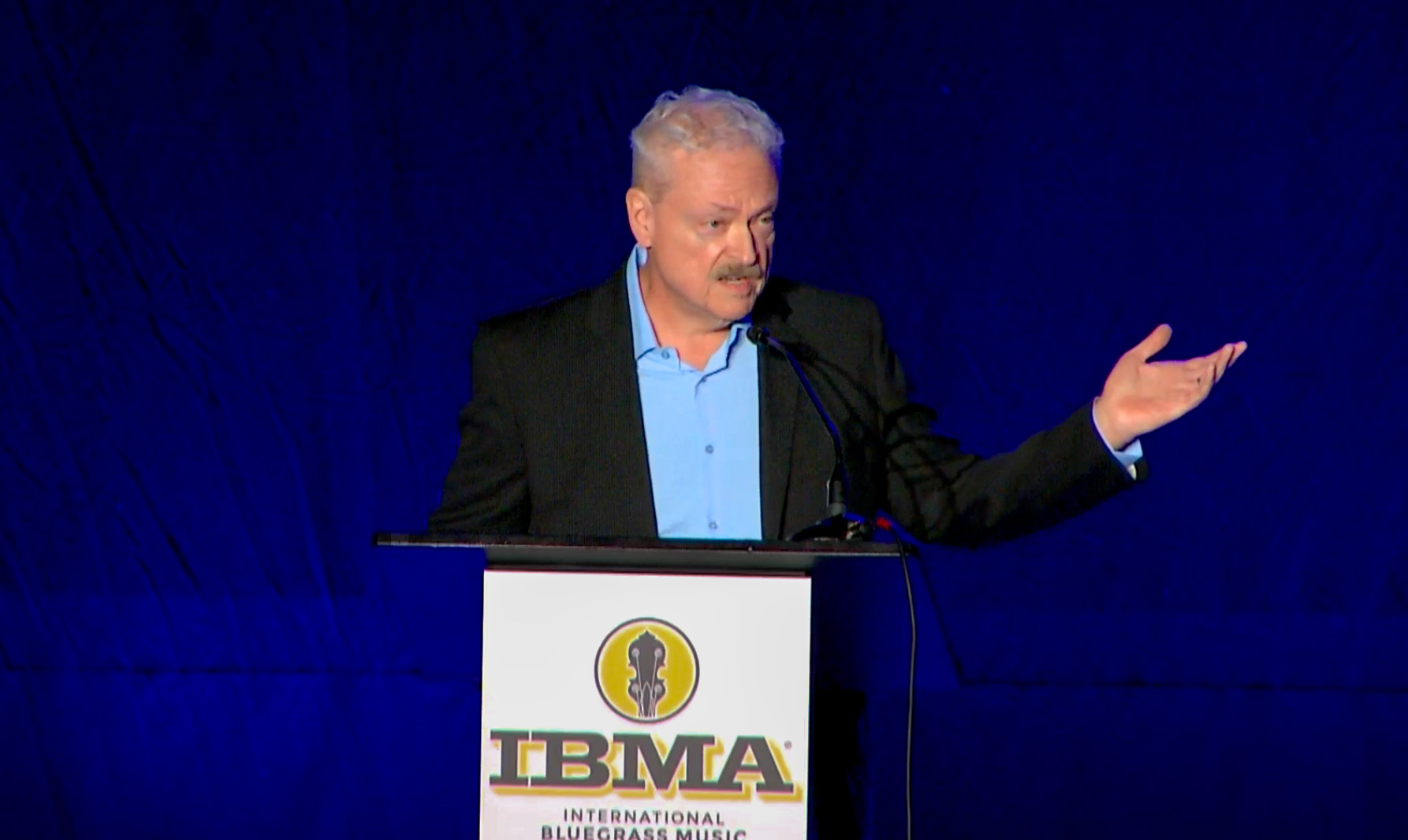
Tim Stafford had the toughest job at this year’s World of Bluegrass conference in Chattanooga: Delivering a keynote address in the wake of last year’s still-talked-about address by Billy Strings.
No one will be asking Billy Who, but the Blue Highway frontman nailed his assignment, underscoring that there’s plenty of room for all kinds of music and people under the bluegrass tent.
Stafford spoke as an elder statesman of bluegrass, but he noted that he was much closer to Billy’s age when he delivered his first IBMA keynote in Owensboro, KY, in 1994.
Much has changed since then, but much has remained the same, he noted, harkening back to his remarks as a picker in his mid-30s, in a fledgling band with big dreams and a debut record, It’s A Long, Long Road.
The then-and-now perspective was a novel approach that helped underscore the idea that change, though often difficult to accept, is a key part of growth. Then, there were no smart phones. And talented musicians could make a decent living peddling CDs and making demos for songwriters to pitch. Now CDs are largely relics of a bygone era and artificial intelligence has all but put demo producers out of business.
Stafford said he sees benefits and problems with AI, but that he’s sticking to the practices that have made Blue Highway a top band and has earned him three Songwriter of the Year awards.
“I’m going to write and teach the way I always have,” he said. “I’d love to keep writing songs the way God intended, on Zoom, and with the help of online rhyming dictionaries.”
One of the biggest and best changes he’s seen in the years between keynotes is the growing number of women in bluegrass. The proof, he said, is in music camp registrations, in which women make up the majority of students in most of his classes.
So what hasn’t changed? Now, as then, there is a need to get more kids playing bluegrass. (One sign of success in that department: This year there are 15 college bands registered for World of Bluegrass).
And there’s still too much grousing about what is and isn’t bluegrass. “Billy Strings? Bluegrass. Del McCoury and Larry Sparks? Bluegrass,” he said. “It’s time to close the ranks.”
Stafford is clearly part of the can’t-we-all-get-along camp. “I don’t care about your politics,” or any other topics that are dividing the country in a way that few probably imagined back in the mid-1990s. “I don’t care, just as long as you love bluegrass.”
He’s also from the Billy-Strings-is-great-for-bluegrass camp. “What a wonderful and humble guy,” Stafford said, retelling the younger artist’s wonder at seeing 10,000 fans staring back at him on stage. He recalled Strings saying, “Sometimes I look out there and think ‘why me?'” Then thinking that as long as they’re there to hear him, “I’m going to shove some Stanley Brothers right up in their faces.”
The bottom line, Stafford said, is that bluegrass “is growing, and it’s poised for much more growth.”
Why?
Because bluegrass is about “real people getting to play real music.”
I won’t be around, but I hope three decades from now Billy Strings will get the chance to look back on his first keynote address, and Stafford’s second, and marvel at the growing force that bluegrass was in the process of becoming when IBMA moved World of Bluegrass to Chattanooga.