

Today, November 4, marks the deadline for applications for the position of executive director of the International Bluegrass Music Association. The selection itself will come later, but the stakes could hardly be higher. IBMA’s IRS tax returns document three consecutive fiscal years of losses, totaling more than $863,000 through June 2025. Now interim executive director Paul Schiminger has confirmed a fourth annual deficit for the year ending June 2026, along with a further decline in the association’s net assets. The new year’s figures have not yet been audited, and we still don’t know IBMA’s present cash position. Schiminger responded in writing to our questions and provided independent audits covering fiscal 2022 through 2025, giving us a clearer understanding of the financial difficulties, and the measures being taken to address them.
The qualifications that matter most in IBMA’s next executive director may not be the ones that first come to mind. A deep knowledge of bluegrass music? Certainly helpful. Strong industry relationships? All the better. A genuine passion for the music? We’d certainly hope so. But right now IBMA needs someone who knows how to turn around a struggling business, working with a board prepared to support that effort and accept responsibility for decisions of its own. That’s not a criticism of the people who have served IBMA so faithfully. It’s recognition that hard work and good intentions, by themselves, cannot balance the books.
The numbers tell the story
Seven full fiscal years of IRS Form 990 filings tell the story. These are the association’s tax-return figures, rather than the separately presented audited consolidated results that also include the IBMA Trust Fund:
| Fiscal year | Revenue | Expenses | Surplus / deficit |
| 2019 | $1,470,911 | $1,460,148 | +$10,763 |
| 2020 | $1,482,476 | $1,362,774 | +$119,702 |
| 2021 | $892,850 | $728,950 | +$163,900 |
| 2022 | $1,560,553 | $1,254,880 | +$305,673 |
| 2023 | $1,405,959 | $1,479,294 | −$73,335 |
| 2024 | $1,255,021 | $1,575,954 | −$320,933 |
| 2025 | $1,343,031 | $1,811,805 | −$468,774 |
Fiscal years ending June 30. Source: IBMA Form 990 returns (association-only tax reporting). The audited combined results also include the separate IBMA Trust Fund.
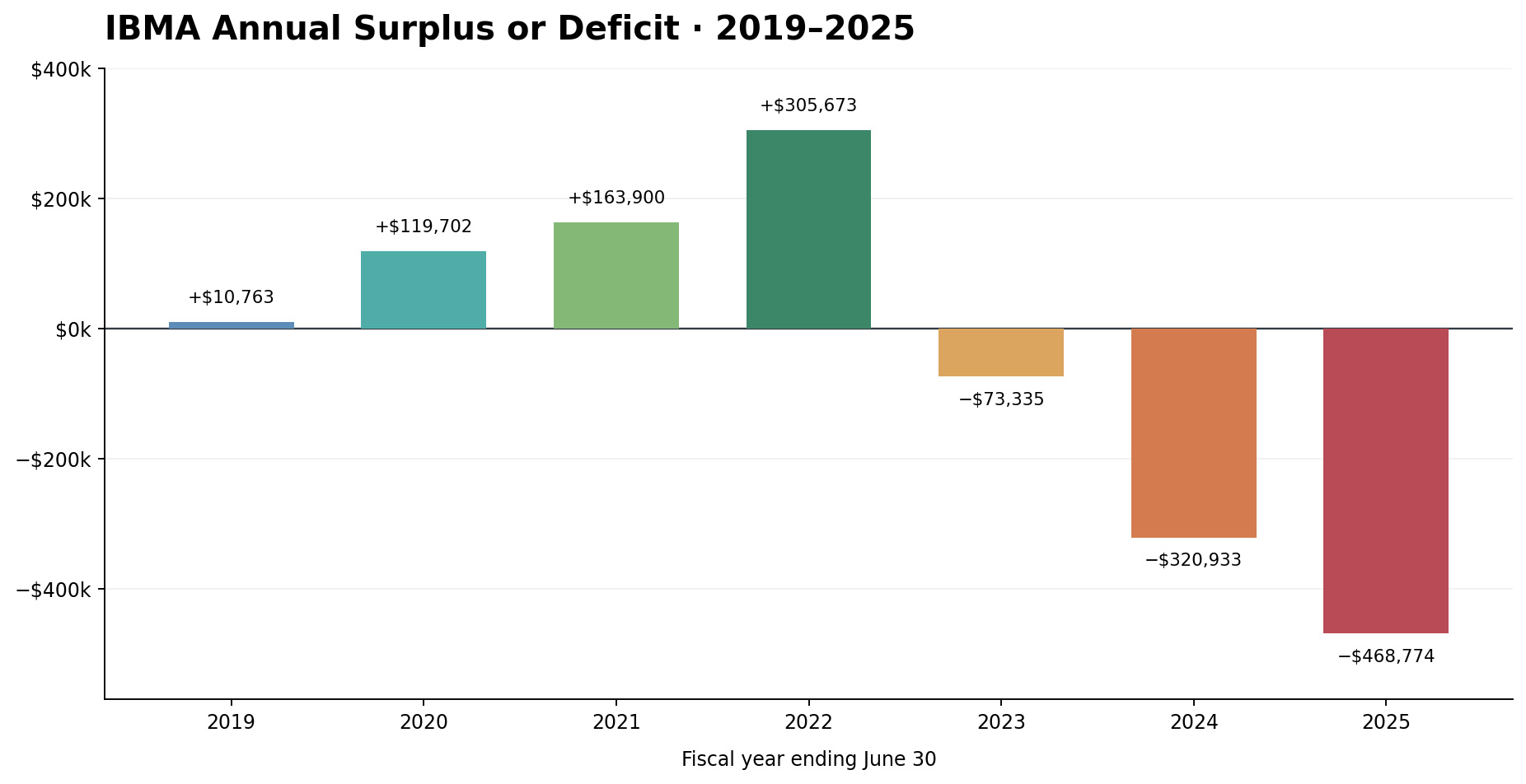
After a $305,673 surplus in fiscal 2022, the tax returns show deficits of $73,335, $320,933 and $468,774 in successive years—$863,042 altogether.
In fiscal 2025, IBMA spent approximately $1.35 for every dollar received, an annual accounting deficit equivalent to about $39,000 a month. That’s not the same as monthly cash burn. The audited association-only statements also show a loss of roughly $469,000 in fiscal 2025, although the audit and tax-return presentations differ somewhat in other years. And now we know the losses did not end there.
In a November 3 follow-up, Schiminger confirmed that IBMA ran another deficit for the fiscal year ending June 30, 2026, as the inaugural Chattanooga festival cost substantially more than expected, and ticket sales were softer than projected. He said net assets declined further and that the more optimistic outlook expressed in the January 2026 audit was not realized. He has not released preliminary dollar amounts because the Executive Committee wants to await the audit and any necessary accounting adjustments. Thus the bar chart shows seven completed tax-return years, while the fourth consecutive deficit is confirmed separately by IBMA’s interim executive director.
The audited statements allow us to be much more specific about the balance sheet. IBMA itself had $684,517 in cash at June 30, 2025, down from $1,154,757 three years earlier, and negative net assets of $130,642. The consolidated accounts, which also include the separately purposed IBMA Trust Fund, reported $1,055,473 in cash and positive net assets of $326,234. Those larger consolidated figures should not be mistaken for resources freely available to IBMA’s operating budget; the Trust Fund exists to provide emergency assistance to bluegrass professionals.
The association’s balance sheet also carried $823,721 in deferred revenue, including $528,169 in advance Chattanooga-related grant funding, $247,404 in advance event revenue, and $48,148 in membership dues. Deferred revenue generally means cash received or billed before the organization has delivered the event or service that earns it. It is not an overdue bill or a demand to refund all that money. The grant portion, for example, was expected to be recognized as revenue after the September 2025 World of Bluegrass event. But it helps explain why a bank balance cannot be treated as money available without regard to upcoming commitments. The audit documents both the risks and the importance of understanding the timing.
How We Got Here
Schiminger’s account adds context that tax returns alone cannot provide. During his earlier tenure, IBMA converted to a 501(c)(3) nonprofit in late 2017, expanded fundraising for its Trust Fund, and negotiated better financial terms with Raleigh in 2018. He says reserves grew from roughly $130,000 in 2015 to more than $600,000 by June 2021, aided by strong attendance, grants, donations, and federal pandemic assistance.
The COVID experience is especially revealing. World of Bluegrass moved entirely online in 2020, eliminating major convention and production expenses. IBMA reported significant surpluses during the pandemic and early recovery years, but the audits reveal a crucial ingredient in the 2022 result: $443,807 in federal Shuttered Venue Operators Grant revenue. That assistance and the unusual event format mean we shouldn’t portray those surpluses as evidence that IBMA’s ordinary in-person business model was thriving. They do demonstrate how sharply the economics change when event costs—and outside support—change.
As live events returned, Schiminger says inflation increased production costs while festival attendance softened. He describes World of Bluegrass gatherings from 2022 through 2025 as financially difficult, with the last Raleigh event in 2024 particularly challenging. IBMA’s losses therefore preceded Chattanooga, although the new location introduced its own financial issues. And the prospect of another economic downturn makes the need for genuinely available reserves that much more important.
Chattanooga’s financial reality
The three-year agreement to bring World of Bluegrass to Chattanooga covers 2025 through 2027. The new location offers a well-regarded convention center, a positive attendee experience, and an enthusiastic host community. The newly supplied audit also identifies a master hosting agreement with Chattanooga Tourism Co., and a related Tennessee grant award of $656,892 to support the events. Of that arrangement, IBMA had received $528,169 in advance by June 2025, which is why the money was carried as deferred grant revenue rather than recorded as earned income that year.
But the first Chattanooga festival underperformed its budget by approximately $471,000, Schiminger reports: $189,000 less revenue than expected and $282,000 in expenses above projections. This was a budget variance, not a verified $471,000 net loss. He says the conference and awards show were closer to plan, while festival production, multiple stages, fencing, security, and emergency medical services contributed to the overruns. Although the event benefited from more than $500,000 in state grant support, Paul was candid that it was not financially successful for IBMA.
The gathering nevertheless produced substantial benefits for the host community. Schiminger reports more than $13 million in direct economic impact for Chattanooga and Hamilton County, including approximately $1 million in sales tax revenue. That’s welcome news, but visitor spending is not the same as revenue earned by the event producer. A festival can be a success for its host city and still be a difficult proposition for the organization putting it on.
Complicating matters, IBMA had expected it might qualify for Tennessee state grant support in consecutive years, but subsequently learned the grant would not be available for the fall 2026 event. Schiminger says costs were reduced, yet final results for that gathering remain under review as invoices and revenues are reconciled. It is important to keep the accounting periods straight: the fiscal year ending June 2026 covers the September 2025 inaugural Chattanooga event; the fall 2026 gathering falls in fiscal 2027. The board is also evaluating the size and cost of its awards show, which Paul says has run deficits for several years.
The January 2026 audit provides important context. In its going-concern note, management said it expected sufficient resources to continue operating, and anticipated substantial improvement in fiscal 2026 net assets, partly as more than $528,000 in deferred Chattanooga grant funding became recognizable revenue. The independent auditors issued an unmodified opinion on those statements. But Paul’s latest reply makes an essential correction: management’s confidence rested partly on expectations about recurring state grant eligibility that did not hold, while the inaugural festival’s expenses and ticket receipts proved disappointing. He says the anticipated improvement did not materialize. That’s a sobering result, though it does not establish that IBMA is unable to pay its bills today.
That leaves Chattanooga’s central question unresolved. With one year remaining under the announced agreement, IBMA needs the full economics of its conference, festival, and awards show before committing itself to another term. The audit also discloses hotel room-block commitments and potential cancellation charges for the 2025 gathering, although management says the association has never incurred penalties under such arrangements. Existing contractual obligations help explain why an event cannot always be resized overnight.
Fundraising cannot wait
Paul’s responses make clear that the board has already taken steps to strengthen fundraising. It established an Advancement Committee late last year, authorized an annual campaign and is broadening its pursuit of charitable gifts, foundations, and grants. He also credited support from Chattanooga-area foundations, including Benwood, Riverview, Lyndhurst, Bobby Stone and McKenzie. In his latest reply he said management had secured larger private-foundation commitments expected to continue next year, identified ways to reduce spending, and renewed its advancement effort. Those are encouraging developments, although commitments and plans aren’t the same as funds already collected or deficits already reversed. The audits also show how exposed IBMA can be when extraordinary grants are not repeated.
I would also encourage the board to consider engaging an experienced fundraising consultant or development firm to help accelerate the efforts already underway. A consultant could help pursue near-term sponsorships, major gifts and other support while laying the groundwork for grants that may take years to develop, without immediately adding another permanent position. Paul rightly notes that bluegrass professionals cannot be charged the registration and exhibitor fees customary in larger industries. Broadening the support base is therefore essential to keeping the association accessible to the people it exists to serve.
The board’s fundraising initiatives are encouraging, but Schiminger’s confirmation of another deficit makes the urgency unmistakable. The question is whether new support and cost reductions can reverse the decline before further reserves are lost. That is why access to timely financial information matters.
Financial stewardship and transparency
IBMA maintains a website archive for financial statements, board minutes, and governance documents, but the latest audit linked there dates to 2018 and the minutes we’ve located to 2019. After our requests, Schiminger provided audited financial statements for fiscal 2022 through 2025, for which I am grateful. He also explained that the Executive Committee prefers not to release fiscal 2026’s unaudited figures because the bookkeeper’s entries may require adjustments. The next audit is expected to begin shortly. That is a reasonable distinction between completed audits and preliminary accounts, and Paul has now confirmed in writing the direction of the latest results.
What we can now say is that IBMA suffered another annual deficit through June 2026 and that its net assets declined further. What we still cannot determine is the size of that deficit, IBMA’s present cash balance or the final financial outcome of the fall 2026 World of Bluegrass. Schiminger says the current operating budget is balanced; that’s encouraging, but a balanced budget is a plan, not cash already received, a completed surplus or proof that depleted reserves have been rebuilt.
I have also formally requested five years of board minutes and records of official actions, along with relevant financial history, to better understand how the association has addressed its changing circumstances. We intend to revisit IBMA’s finances when the fiscal 2026 audit and additional statements become available. Paul’s cooperation has helped establish what happened during the latest completed fiscal year, even while the exact figures remain unavailable pending audit.
Financial disclosure is ultimately a responsibility of the board, not an administrative favor dependent on whoever is serving as executive director. IBMA isn’t required to post every audit or board minute publicly, but members should have a clear and dependable process for obtaining the records they are entitled to review. Ready access to current financial information also helps members, potential donors, and foundations considering the organization’s requests for support.
And to be fair to Paul, stepping into the interim executive director position with only a few months to prepare for World of Bluegrass was a yeoman’s job. He has earned some breathing room after that effort, and I’m grateful he took the time to answer our questions and provide the audits. The need for continued scrutiny belongs to the organization and its board, not to a personal criticism of the man who answered the call.
The next leader, and the board behind that person
The next executive director needs proven ability in financial management, fundraising, nonprofit leadership, and organizational change. The job description recognizes those qualities, and Schiminger says they will carry substantial weight in choosing a candidate. At the same time, a capable business executive who doesn’t know bluegrass may not immediately understand the history, relationships, and delicate balance that sustain IBMA. That’s where an experienced board can provide institutional perspective without micromanaging the person hired to lead.
Paul himself embodies that institutional knowledge. After serving as executive director from 2015 to 2021, he returned as interim leader following Pat Morris’s departure in 2023, and again after Ken White’s resignation this year. He has also been elected board chair for the coming year, with a board term extending through 2029. That continuity may be invaluable, but the responsibility for financial oversight and hard decisions belongs to every board member. An independent audit is important; so are regular financial reports, spending controls and board members equipped to ask questions. Formal orientation and financial training, if they are not already standard practice, would help strengthen that oversight.
There is one difference in timing worth debating. Schiminger says the board intends to work with the incoming executive director on a comprehensive strategic plan, with measurable goals once the new leader understands the organization. That makes sense for long-term direction, but the board should not have to wait for a hiring process that could take months before accelerating financial stabilization. It already has an Advancement Committee, an interim executive director with experience, and the authority to act. There is no reason the work cannot begin—or continue with added urgency—today.
The immediate agenda should include a realistic cash-flow forecast, a disciplined review of avoidable expenses within existing contracts, professional support for short-term fundraising and long-term grant development, and clear milestones for the economics of World of Bluegrass. Those plans should be measurable, and the board must provide the incoming executive director the resources and latitude to carry them out, while retaining its own responsibility for independent oversight.
The question ahead
For more than four decades, IBMA has served people who care deeply about bluegrass music. Paul and the board have described meaningful steps toward recovery, including stronger commitments from foundations, expense reductions, and renewed fundraising. Those initiatives deserve recognition. But the financial reality is now more serious than the published tax returns alone suggested: IBMA has recorded a fourth consecutive annual deficit, its net assets have declined again, and the January audit’s anticipated improvement did not occur. Without the new audit and an updated cash statement, we cannot determine how much financial flexibility remains.
IBMA doesn’t need a familiar name in bluegrass as its next executive director. It needs a capable business leader supported by an informed, engaged board willing to make difficult decisions, and accept responsibility for the organization’s financial future. Schiminger says management remains cautiously confident because of additional foundation commitments, lower costs, and a stronger development effort. IBMA may also be eligible to seek state grant support in 2027, though that is an opportunity to apply, not guaranteed funding. Those are reasons for hope, not yet proof of a turnaround.
Can IBMA turn things around? I certainly hope so, and I believe its members and the broader bluegrass community do, too. But hope is not a strategy. Recovery will require sound financial management, meaningful board oversight, and the willingness to make difficult decisions while there is still time. Assuming, of course, there is.