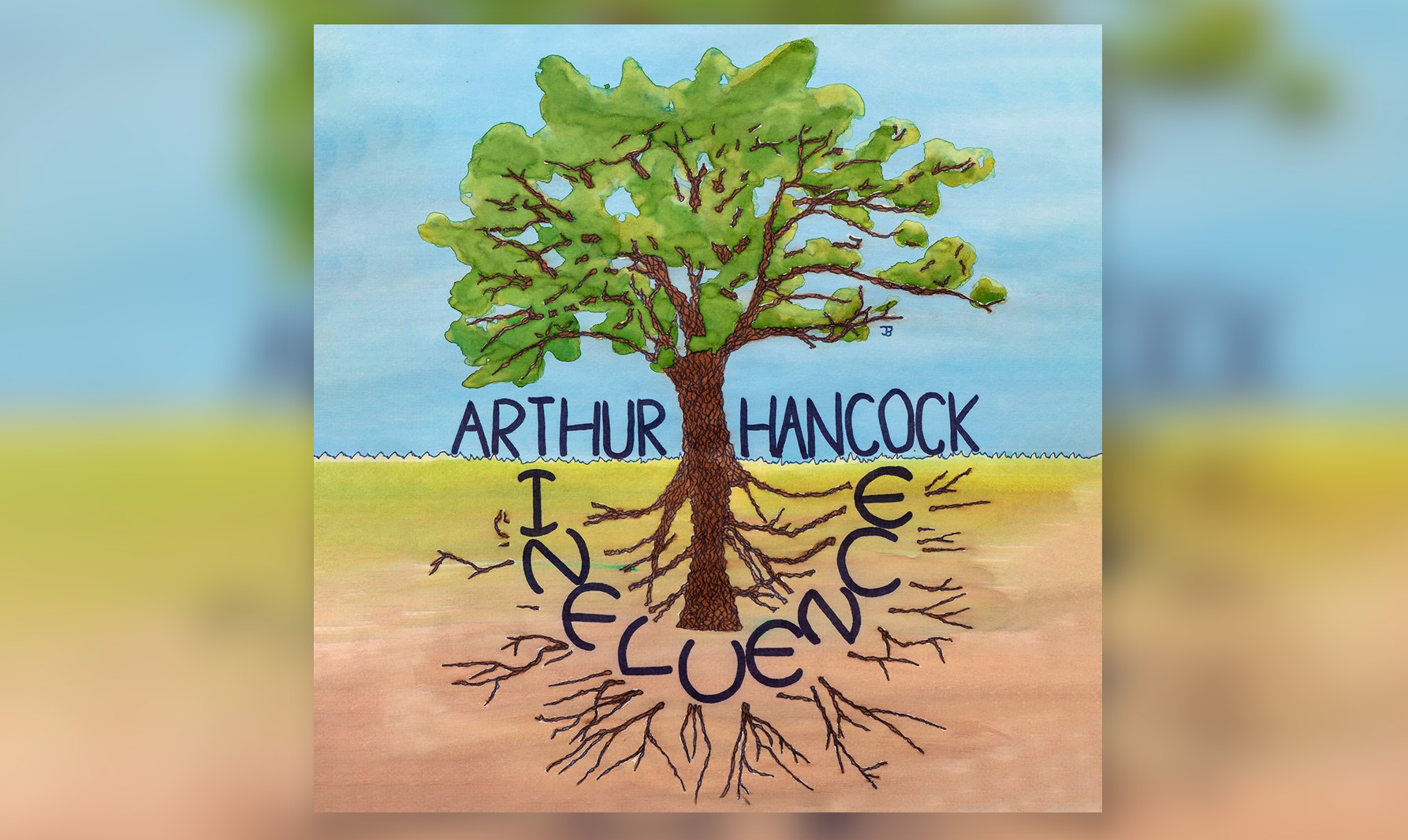
Kentucky singer Arthur Hancock’s latest album, Influence, is a tribute to his songwriting heroes, especially his father, Arthur Hancock III, a songwriter, singer, and guitarist recently inducted into the Kentucky Music Hall of Fame. After seeing a young Peter Rowan perform with Bill Monroe, Arthur III became a fan and then a close friend. He later transmitted his love of bluegrass and beyond to Arthur IV. Two of the father’s original songs are represented on the recording, along with one written by the son.
Arthur made his mark in bluegrass in The Wooks, which he founded in 2014. He played banjo in that band but had to step away after an ergonomic injury forced him to curtail his picking. He continues to perform as a solo artist and in the duo Hancock & Shouse.
On this album Arthur plays guitar on three tracks and sings lead throughout. He has pulled together a stellar lineup of pickers: the core band is Christian Ward (Travelin’ McCourys, Del McCoury Band) on fiddle, Jacob Burleson (currently touring with Alison Krauss and Union Station) on bass, Jake Stargel (Mountain Heart, Sierra Hull) on guitar, and Harry Clark and Cory Walker (both East Nash Grass) on mandolin and banjo. Gaven Largent (East Nash Grass, Dan Tyminski Band) plays reso guitar on four tracks. Needless to say, the band sounds great.
And they have interesting material to work with. Arthur has chosen lesser-heard numbers by respected singer-songwriters including Gordon Lightfoot, Townes Van Zandt, and Robert Earl Keen. Train Song is a good one by Andrew Marlin (Mighty Poplar, Watchhouse), and sounds a bit as if Been All ‘Round This World had been written by Norman Blake. Norman himself is represented by his Down Home Summertime Blues, performed with a bluesy bounce and reso-guitar work by Jerry Douglas.
Going Up On the Mountain is one of the more traditional bluegrass tracks, and one of the best-suited to Arthur’s voice, which is on the low and slightly growly side. Robert Greer of Town Mountain provides good harmony support, as he does on three more songs. The song’s author is unknown, but it’s been recorded by Peter Rowan, who is probably the influence being cited here.
On the more progressive side, Arthur has a nice light touch on the breezy and sweet Gringo Honeymoon. His self-penned Then I’m Gone has more of a laid-back country-folk-rock feel and a less conventional structure.
The album closes on a quirky note, with a hard-driving bluegrass version of When You See Those Flying Saucers, an unlikely gospel number originally done in the late 1940s by the Buchanan Brothers, and covered by the Charles River Valley Boys and Dry Branch Fire Squad.
The recording was produced by Arthur along with Harry Clark and Cory Walker, mixed by Jake Stargel, engineered by Daniel Rice at Soundwave in Nashville TN, and mastered by Ron Rice.
Give Influence a listen and explore the songs and songwriters that have shaped Arthur Hancock’s musical life.