Virtuosos Renee Fleming and Béla Fleck joined together to create The Fiddle and The Drum, an absolutely stunning celebration of Appalachian folk music.
We have come to expect high standards from the world-renowned opera singer who is steeped in the power of music, and the 19 time Grammied banjoist who is noted for his interesting collaborations. But, this — The Fiddle and The Drum — is straight-up brilliant and beautiful.
From the first delicate guitar strum and low sung note in He’s Gone Away, to the last striking long hold in Pretty Bird, The Fiddle and The Drum takes us on a journey into ten connected songs that reflect upon love, loss, war, loyalty, and the like. Each song is a poem from the days before, but with words and messages that are ever timeless and so relevant today. They are set to music this time with the unmatched, dignified voice of Fleming and the masterful playing of bluegrass’s elite: Fleck, Sam Bush, Bryan Sutton, Jerry Douglas, Stuart Duncan, and Mike Bub. Every note on this album is perfectly placed and oh so gracefully so. It is the epitome of elegance.
And, if that is not enough, the one and only Dolly Parton joins Fleming and Fleck on an amazing version of In The Pines. When Dolly drops in on the first chorus, you cannot help but shiver with full body chills. She just knocks it out of the park, second stanza and all, with the band just showing off their best behind her. And, get this: Vince Gill is featured on The Scarlet Tide. His voice paired with Fleming’s is smooth. Add those high fiddle cries and wow. Vocalists Aoife O’Donovan, Kai Welch, Sierra Hull, and Sarah Jarosz join in as well on various tracks, with the latter two joining Fleming for a unique Pretty Bird as a round.
The title track is breathtaking with Fleming’s moving anti-war plea, and Douglas’’ dobro deeply boring into our souls. Sam’s sparkly clean mandolin runs which open In the Pines are also prominent back-up on My Epitaph. It is on this one that we also get to hear Fleck throw down, grooving with his distinctive, driving style. While starting almost hymn-like with Fleming grieving an impending goodbye, Blackest Crow catches us with a contagious beat ignited by Béla’s banjo cascade into each master musician showing us what they’ve got. It unfolds into a formidable bluegrass-y anthem of devotion.
Each song on this album was hand-picked by Fleming and Fleck. Each has a story that needs to be heard: yesterday, today, and tomorrow.
I was one of the lucky ones who witnessed Fleming and Fleck perform songs from The Fiddle and The Drum during the Telluride Bluegrass Festival. I still have goosebumps from that show. I was also lucky to get to talk with Fleck post-Festival about this project. Here is what he said:
JH: What was the original vision for The Fiddle and The Drum? I read that the idea for this album started 20 years ago. How did it actually come about?
BF: I received a call from the label who Renee was signed with, and they asked me if I would be interested in producing some tracks for her. She wanted to explore the folk world and the roots world. I wasn’t sure what that would be like, so we got together and spent some time talking, and I liked her, and I think she liked me. We got together in Nashville, and spent two days in the studio back then. I put together an A-team of people because I really wanted her to hear how good it could be.
We got our demo recordings back then, and it turned out really good. But then, it just sort of sat there for a decade. I would run into her from time to time, for instance in China, when I was there with Abigail, Renee was at the Ambassador’s house when we were performing there, and she said, “Oh, you guys should come to my gig tomorrow if you want, I’m playing with the symphony.” So, we went to see her sing with the Beijing Symphony, and she blew me away! I mean, I hadn’t ever really heard her do her thing, except when we were doing a little bit of exploring during those demos. I was just blown away. I was like, “Whoa, she is unbelievable!”
That was a neat thing to learn, since I didn’t know much about opera. Like a lot of things, when you don’t know something well, it’s alien to you, and you don’t know if you like it yet. Branford Marsalis was always saying, “Man, opera is the best.” When we were together, he’d be telling me, “You got to check out this, you got to check out that.” But, it wasn’t my thing. However, after hearing Renee, it kind of reminded me of my experience with basketball, which wasn’t my thing either until I saw Michael Jordan play. When I saw him play, it was like, “Oh, I can’t not watch this.” It was similar with Renee. She is like the Michael Jordan of lyric sopranos.
So, anyway, she said, “Oh, my mom and my daughter love those demos, they keep saying I should finish them,” and I said, “Well, just let me know when.” A few more years went by, and we ran into each other a few more times, and then she said, “Hey, let’s do it,” and I said, “Okay, let’s do it.” So, then we did it.
I got Jerry Douglas in and Sierra Hull and Sarah Jarosz to come in and sing, and Dolly agreed to do a song, and Vince Gill, and it ended up realizing itself. It just took a long, long time to get there. I feel very proud of it. I didn’t know how it was going to work out with someone from an opera background singing this stuff, but what Renee did, which was so interesting to me, was she dropped everything out of what she calls her “operatic range,” and pitched the songs lower; her voice had a very different emotive quality in that register, which really made it work.
There is a history in folk music of people that come from different worlds singing it. This project fits into the greater lineage of how folk music can be a lot of different things. Also, Renee did have the background. She grew up with a lot of the music that I grew up with, and had the same openness to it. It ended up being a very joyful record to make. Then we started doing gigs, and the gigs were interesting and a lot of fun. It is a different version of all this music; it is a way to be playing in an earthy acoustic music situation without repeating ourselves by doing something in a way that’s already been done.
JH: I read that you had a list of over 100 songs for the album! How did you whittle them down?
BF: I’m very picky, and she is too. I looked at the list and with certain songs, I was like, “Oh, well, that’s a great song – and that’s a great song.” So, I shared the ones that I really liked, that jumped out to me, and she was amenable to trying them because she liked a lot of the songs on the list. I’d say she came up with the list at first, but I had plenty of input. We ended up with what I felt was a list of great songs that I would love to be involved with.
JH: This might be asking you to choose a child, but are there any songs on the album that speak to you more than the others? Or give you the goosebumps or something like that?
BF: I’ve gotten to where I’m very emotionally committed to all the songs at this point, after performing them, working on them with the band, recording them, and going through the whole process, but I do really love The Blackest Crow. Also Pretty Bird, which I’ve always loved, but I think we managed to find a different window into it that justifies yet another version of one of the greatest songs ever.
I don’t get to play music with goosebumps that often, so I really liked having that experience of playing those songs with Renee, and getting to experience that feeling on stage, because it is a marvelous feeling when you can evoke that much emotion.
JH: Speaking of goosebumps, what did it mean to you to have Dolly Parton on the album, and what were your thoughts when you first heard her voice on In the Pines?
BF: Oh my God! I’m such a Dolly Parton fan, ever since I lived in Kentucky, and I started falling in love with her records. Gosh, she’s one person where it’s pretty hard to find anybody who doesn’t love. She is such a good human and such an incredible artist.
Renee said, “Well, what do you think about Dolly?” I said, “Well, I think she’s hard to get! But, we can give it a go.” So, I thought, “Well, how can we make this really fun and simple for her?” I thought it might work best if we sent her a finished track of a song she already knew – and she knew all the people on the track. I sent a note to her management, saying this is a request from Renee Fleming and Béla Fleck, and this track has Sam Bush, Jerry Douglas, Bryan Sutton, and Stuart Duncan on it, you know, all people who had played with her in her bands when she was doing her bluegrass stuff. I thought this is probably the best shot we have.
Amazingly enough, I got an email: “Dolly’s going to do it next Thursday.” “Oh my God, can I come by?” And, they said, nope, she likes to sing on Thursdays and she likes to do it on her own. So, of course, I’m biting my nails. “What’s gonna happen?” Finally, the track shows up, and it blew my mind! I mean, it was so good! You can hear it. You can hear exactly what I heard because it was done. She had done it. Well, she hadn’t just ‘done it.’ She entered the world of our track and made herself a full-on participant. She obviously studied every section and she knew when to star and stand out, and she knew when to back up and support. Both Renee and I were just knocked out! When she comes in, oh my God, what a lift!
We haven’t really talked about the rest of the songs. When Renee and I got back together and looked at the original demos, we had these six songs that we had first recorded that we came back to, but it wasn’t enough for a record. So, we looked at some more songs and we were trying to figure out what would go with the original six. Finally, I realized that the six songs that we had recorded were part of a storyline. So, I said, “Hey, Renee, I think whatever we choose to go with these songs should be part of the same person’s story.” Love and loss and maybe a woman whose partner goes off to war and never comes back and maybe she’s pregnant when he leaves, which makes Scarlet Ribbons make sense, and Pretty Bird, which is a treatise of that very common storyline in life: women whose best years were given to a situation, and then it all fell apart. There was something to all that, and it seemed like the person that was going through this whole saga on this album could feel that way. So, Pretty Bird, made a lot of sense on the album, and Renee suggested it.
Actually my very first professional gig was playing with Hazel Dickens when she was doing the Harlan County USA at Alice Tully Hall in New York City when Tony Trischka couldn’t do it. I was part of the band for several songs she was singing at the end of the movie, and we ended up being very friendly from then on.
Hazel managed to put this idea into song so beautifully. I was looking for a way to put our own stamp on it and make it different from, for instance, the version I had produced for Abigail and Wu-Fei, which is lovely but very different. I kept wondering, does this song work as a round? It seemed like it might. When Renee came down to record, she sang the song, so we had a great version of her singing it. I went into the studio copied it and delayed it so it started over again on the second line. Then, I tried it again with three Renees staggered, just as an experiment, and I thought this actually could work. Luckily Renee was willing to give it a go. I thought a round that wasn’t a strict round, but one where there was some license would be interesting. And, then it was about finding the right people to do it, and we ended up with perfect folks. Sierra and Sarah both remarked that Renee is able to hold notes for so long, and we rarely do that in bluegrass music in that same way. They were very impressed by her and her instrument [her voice] that she had worked on for so long and developed.
JH: Can you talk a bit about your experience bringing The Fiddle and The Drum to the Telluride Bluegrass Festival and what that meant to you — in that setting, with that audience, with your peers, on that historic stage?
BF: My first year at the Telluride Bluegrass Festival was 1982, and I’ve been to Telluride every year since then, except the one year during the pandemic when they didn’t have it.
Telluride has given me a lot of leeway to try things. They’ve allowed me to bring an orchestra, which was an incredibly expensive move. They’ve allowed me to bring top jazz artists like Chick Corea, Jean-Luc Ponty, Stanley Clarke, and the Marcus Roberts Trio. They’ve allowed me to come with African, Tuvan, and Latin musicians. They have had a lot of trust in me, and I do feel that I have brought something to the festival that hasn’t been there before, that made the festival more diverse.
But, this seemed like it might be a push too far, this opera singer thing, and there was some doubt. But, Craig [Ferguson, the Festival organizer] gave me the rope, and I think we delivered something really unique to the Festival. I’m very thankful that they allowed me to do that, and allow me to keep coming back and trying things there that throw a kink in the way things have been. I think it was a beautiful moment for the Festival, and the Festival again showed its openness and inclusiveness. I was proud to be there with Renee.
JH: Can you name some of your favorite parts about working with Renee Fleming?
BF: Well, for so many years I never got to work with vocalists after New Grass Revival. I have almost always concentrated on instrumental music until I started working with Abigail. That was my first chance to work with a vocalist in a long, long time, and I’ve always had an affinity and love for great female vocal records. It started for me with Emmy Lou, Linda Ronstadt, and Dolly. There was a lot of potential for creativity in that type of vocal music.
So, for me it is a treat to get out of my instrumental zone and get into some music that communicates so directly. With instrumental music, the listeners have to open their ears, bring imagination to it, and paint their own mental picture on top of what we are playing. But, vocal music is much more direct. Some people don’t really listen to lyrics. I really do. I’ve always been very lyric-driven when I’m listening to songs. If I don’t think the lyrics are good, there is not much point, no matter how good the track is or whatever else is going on.
I grew up loving Joni Mitchell’s records, Blue and Court and Spark, and then later on, Night Ride Home. I loved everything she did, but those ones in particular, and her lyrics were always so incredible – thoughtful and brilliant. Lyrics have always been a driver for me. The songs we ended up with all had lyrics I could really get into, and it is a great experience working with Renee, who is one of the great vocalists of our time, even though she is in a different musical family.
JH: Speaking of Joni Mitchell, was it a natural for you to choose her song as the title of your album?
BF: It is a song that I’ve been interested in for a long time. I didn’t even know she wrote it at first. I heard it on a Karan Casey record. Then, Karan collaborated with the Flecktones. We were in Scotland, Abigail was there, and Kathleen MacInnes, who’s a great Scottish singer, and we were looking for three songs that they could sing that overlapped each other, and I thought The Fiddle and The Drum was really interesting to try even apart from the lyrics because it goes back and forth between major and minor a lot. That might be a really interesting part of the fabric of this piece we were weaving.
When Renee and I were looking for songs and I was trying to think of war and anti-war songs that have not been overdone, I presented it to Renee. She loved it. And we created this marvelous version of it with Renee and Jerry in my studio live together. Jerry was unbelievable, and I was excited for her to have the experience of singing with Jerry live because he is such an evocative player and great vocal accompanist. I was just curious what it would bring out in her. Of course they worked beautifully together.
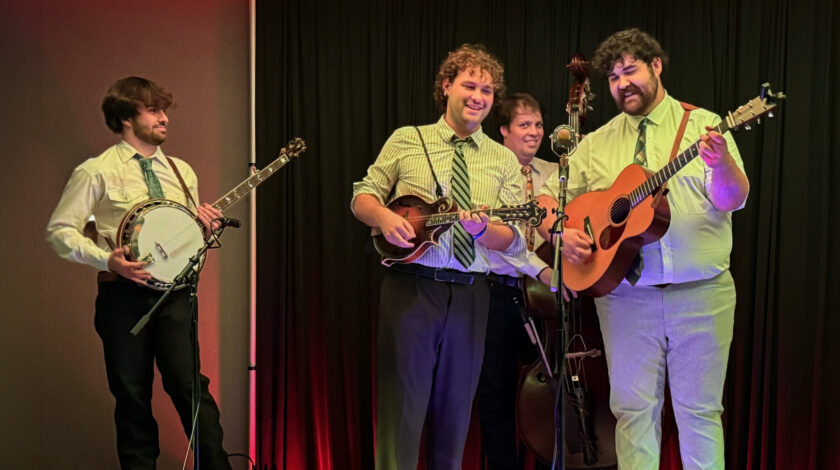
JH: It is amazing. I saw in Telluride that your My Bluegrass Heart band is playing The Fiddle and the Drum songs along with My Bluegrass Heart songs as part of the show, and that you have some new members – Dominick Leslie (mandolin), Jeff Partin (dobro), Jake Stargel (guitar). Do you have any thoughts about a second My Bluegrass Heart album in the future?
BF: Well, that’s the other reason I needed to put this band together — because we’re putting out a live Ryman show that we did with everybody. It was filmed and recorded, and it was just off the charts. It was Billy Strings, Sam, Jerry, Stuart, Michael Cleveland, and Sierra, etc etc. We had a massive cast, and everybody just revved each other up. I feel like it was one of the great concerts I have been a part of. So, we’re releasing that album in September, I believe, and we’re going to be playing My Bluegrass Heart dates to support that. This is the band that’s going to go out for that. I needed a great band that could play all the music, not just the Renee music, for shows, but also for the Heart shows when Renee’s not there.
JH: Regarding playing all the music, you threw something in the mix with these guys, which is Rhapsody in Blue(Grass). That’s amazing, and I thought everyone on the stage in Telluride just slayed their parts on that one.
BF: Yeah, I think there was a lot of anxiety in that performance. Like: are we gonna make it? That’s a hard 12 minutes of music, especially for people who grew up in the bluegrass community. We’ll play things like that on the tour, but I’m also going to dig into older stuff of mine. I might pull out some stuff from Drive, maybe some New Grass Revival stuff, some Bluegrass Sessions stuff, maybe even a Flecktones thing or two. When we come out, it won’t be a new band playing the old band stuff. It will be a good bit of My Bluegrass Heart and then whatever else we can do that I haven’t gotten to play in a long time. We’ll keep it fresh.
JH: One last question: are there any other new collaborations we should look forward to?
BF: Yes. Michael Cleveland and I have recorded a record together that is a very ambitious duo album, covering a lot of different kinds of music from very traditional to fairly progressive. And, there is an orchestra project that I did with Abigail, a song cycle that we perform. There is a special recording of that which we are going to be putting out this year.
Lots to look forward to from Béla Fleck. But, a first order of business should be figuring out if you can catch a Renee Fleming / Béla Fleck The Fiddle and The Drum show. Live, it is amazing. Also awesome is spending time with the album. For me, the first run was eye-opening, the second was absolute intrigue, the third: I am hooked!