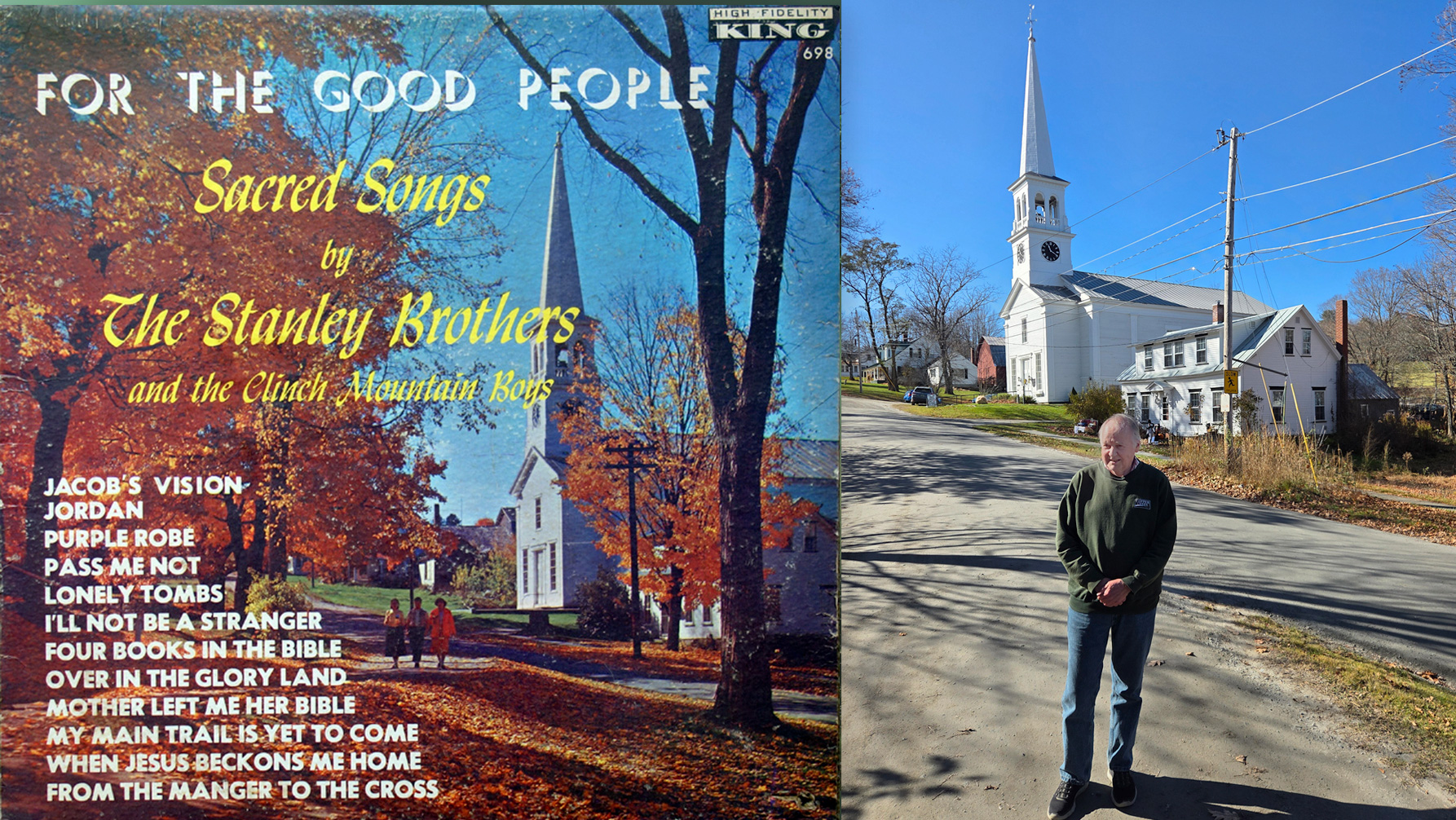
This story of a decades-long search for the church on a Stanley Brothers album cover is a contribution from Gary Reid, an IBMA award-winning author, producer, and longtime bluegrass researcher. His work has documented the lives and music of traditional bluegrass pioneers for over five decades. Gary’s knowledge of The Stanley Brothers’ catalog is without peers.
In the upper-right corner on the back jacket of my copy of For the Good People (King 698), there is a neat, black ink mark: JAN 03 1975. For a short period back in those days, I had a nerdy habit of date-stamping every new arrival to my vinyl collection the moment it came through the door. The practice didn’t last long, and eventually fell by the wayside, but that quiet stamp remains a permanent time capsule.
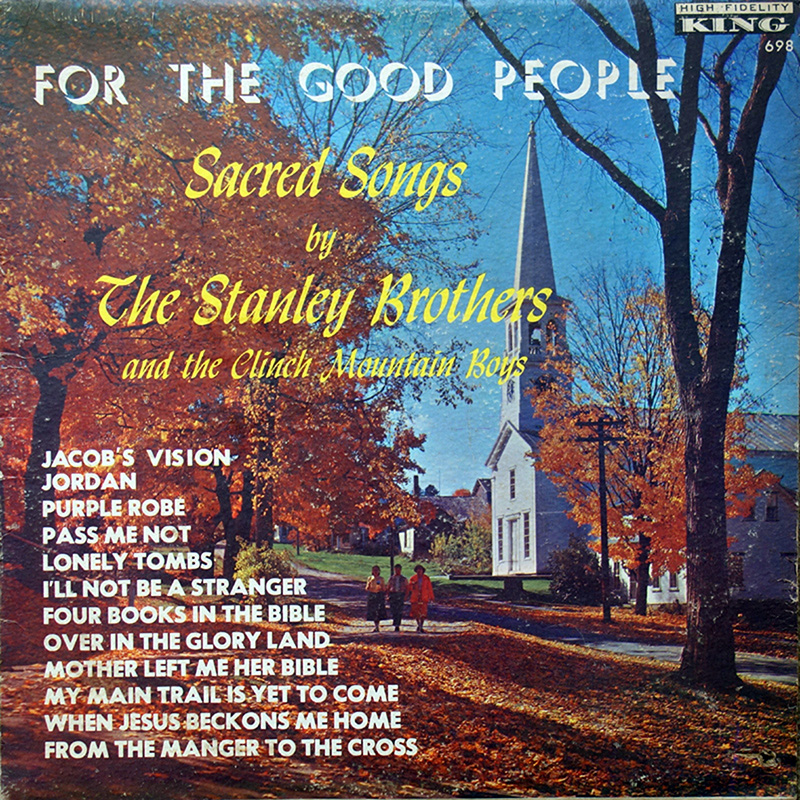
That particular album was recorded by the Stanley Brothers and the Clinch Mountain Boys in a single, marathon session back on September 15, 1959. Released roughly eleven months later in August 1960, it was nearly fifteen years old by the time I stamped my copy as a young record collector. Unlike most bluegrass LPs of the era—which typically showcased the featured band in matching suits posed in some rural setting—King Records opted for a stock photo: a tranquil white wooden church set against vibrant fall foliage under a soft sky.
For years, I naturally assumed the building stood somewhere near Cincinnati, Ohio. King Records was headquartered there on Brewster Avenue, and Syd Nathan’s team frequently used local landmarks from the surrounding Ohio and Kentucky countryside. On several occasions, I spent hours scouring digital archives and road maps trying to locate that exact white church around Southwestern Ohio, but every lead turned up empty.
When the original photograph was taken back in the late 1950s, there were no websites or digital databases to upload images to. One has to wonder how King Records came to use the shot—perhaps through a printed binder or catalog from a stock photography service of the era.
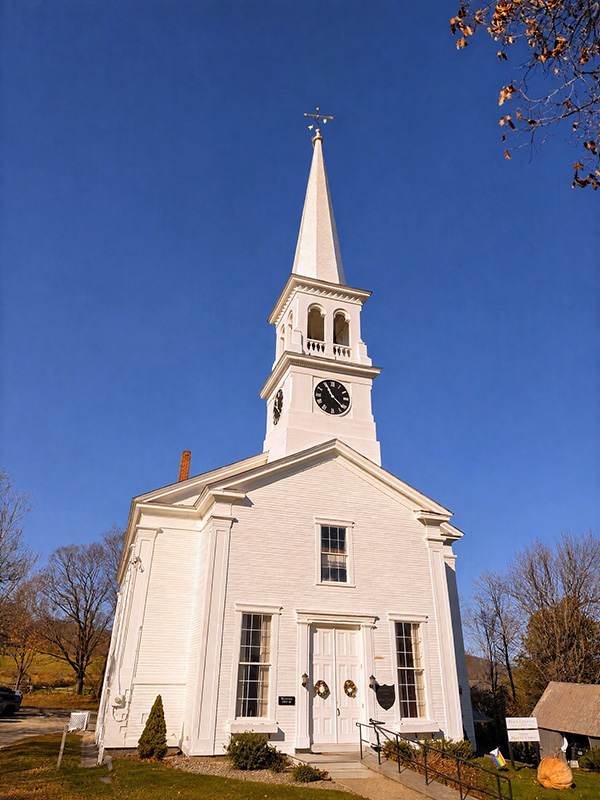
Eventually, I picked up the trail again, and in 2022—forty-seven years after pressing that rubber date stamp to the cardboard—I hit pay dirt. It was a photographer of more recent vintage who, in the early 2000s, had photographed the location and posted her work online. Browsing her website, I instantly recognized the distinctive building and made the connection: it was the historic Peacham Congregational Church in Peacham, Vermont. I reached out to thank her for sharing her work online, finally solving the mystery. As one source later noted, it is considered one of the most photographed churches in New England—making it wonderfully ironic that it had managed to remain hidden from me for so many years.
Having chronicled previous visits to King Records landmarks in a January 2010 Bluegrass Unlimited article (Twenty-Six Hours in Cincinnati: Retracing the Footsteps of the Kings), I never truly expected to stand in front of this particular church. Peacham was simply too far off my usual travel paths.
Then life stepped in.
Back in 2009, when I hatched the idea to create a one-person play about Carter Stanley (A Life of Sorrow), I signed up for two semesters of acting lessons at Virginia Western Community College. My instructor, Ted Mills, became a close friend over the years. Recently, Ted lost his beloved wife, Maggie, after a long illness. She was a New Hampshire native, and Ted planned a solemn trip north to inter her ashes alongside her parents in her hometown cemetery. I offered to tag along, helping to navigate, drive, and (hopefully) be good company.
As we journeyed northward, my thoughts initially centered on Vermont, where my grandmother was born at the turn of the last century. I wondered if we’d be passing any old family haunts. However, it wasn’t long before my thoughts turned to Peacham and the Stanley Brothers album cover.
We stopped for the night (Halloween) in Brattleboro, Vermont. The next day, Sunday, our destination was Jefferson, New Hampshire, and Maggie’s final resting place. Before starting out, I asked Ted about our route for the day. It turned out that Peacham was a scant seven miles from our travels on Interstate 91. It was then I pitched the idea about making a quick detour, cementing the plea with a promise that it would be a spiritual experience. Perhaps not the kind where angels come descending from the heavens, but more cosmic, like when the sun, moon, and stars align in perfect symmetry. Something of that magnitude. Ted was skeptical but readily agreed to the detour.
After a delightful Turkish-inspired breakfast at Tuckerbox in White River Junction, Vermont, we proceeded northward. Exit 18 was the magic number that provided entry to the tiny hamlet of Peacham. It was a place where time seemed to have stood still. There was nothing to indicate that anything new had been erected since the days when the original album cover photo was taken.
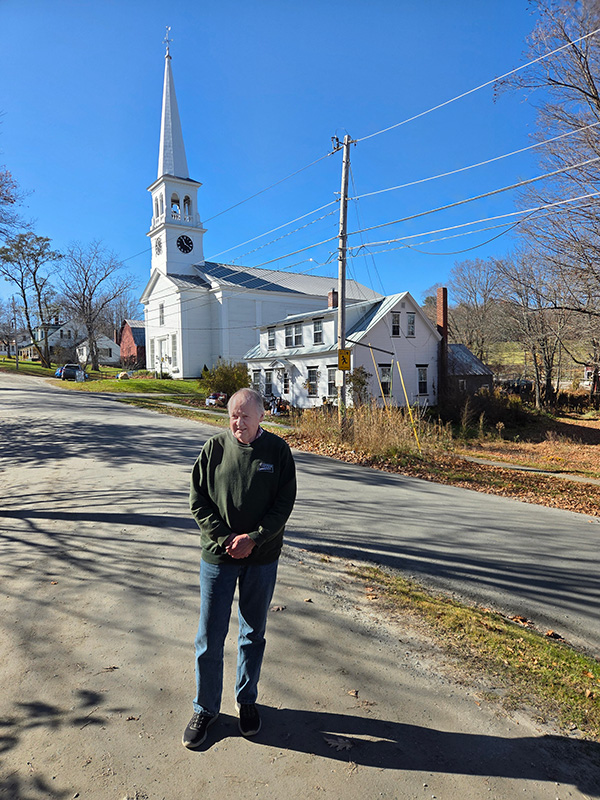
I spied the imposing church steeple as we drove into town. Two minutes later, we stood in front of the church and peered upwards. The towering, crisp white steeple seemed to pierce the brilliant blue sky. I walked around, catching views of the church from different vantage points. The original album cover was ablaze with brilliant fall foliage; unfortunately, we were two weeks too late to have caught sight this year. The cover also showed a trio of people walking on a lane away from the church. I approximated their location and had Ted snap a few photos of me there.
Carter and Ralph Stanley almost certainly never knew where this church stood, nor would they have given a second thought to a stock photo chosen by a graphic design artist in 1960. Yet, their music had created an invisible line connecting a 1959 session in Cincinnati, a 1975 record shelf, a 2009 acting class, and a 2026 roadside stop on a quiet Vermont Sunday morning.
When I posted about the discovery on Facebook later that evening, the traditional music world closed the loop even further. I received a note from Bob Amos, former member of the Colorado-based group Front Range. I had been a fan of the band since the early 1990s and had even promoted a show for them in Roanoke in 1993; Bob has since relocated to Vermont. “Welcome to our neighborhood, Gary!” he wrote. “I’ve played in that church many times.” Yet another bluegrass transplant was aware of and had performed at the church, Banjo Dan Lindner.
Sometimes the music takes you down roads you never planned to travel—and connects you to places and people you were meant to find all along.