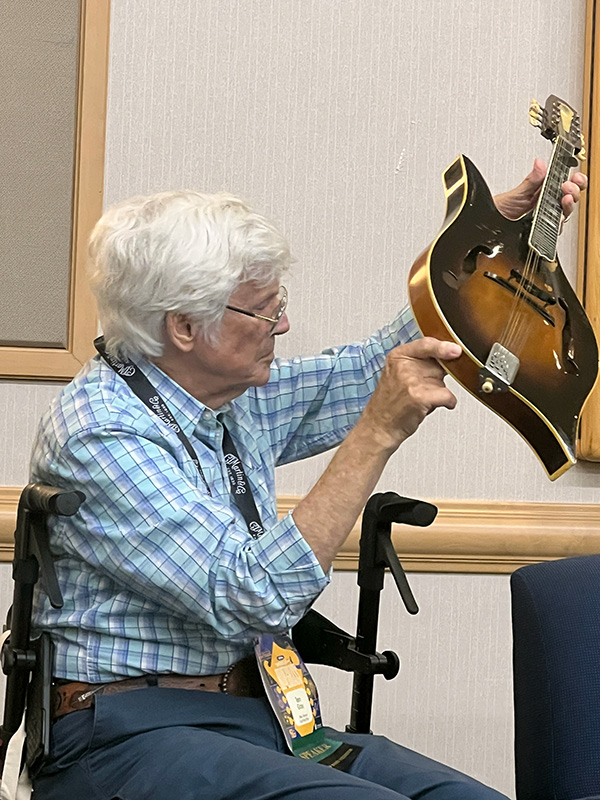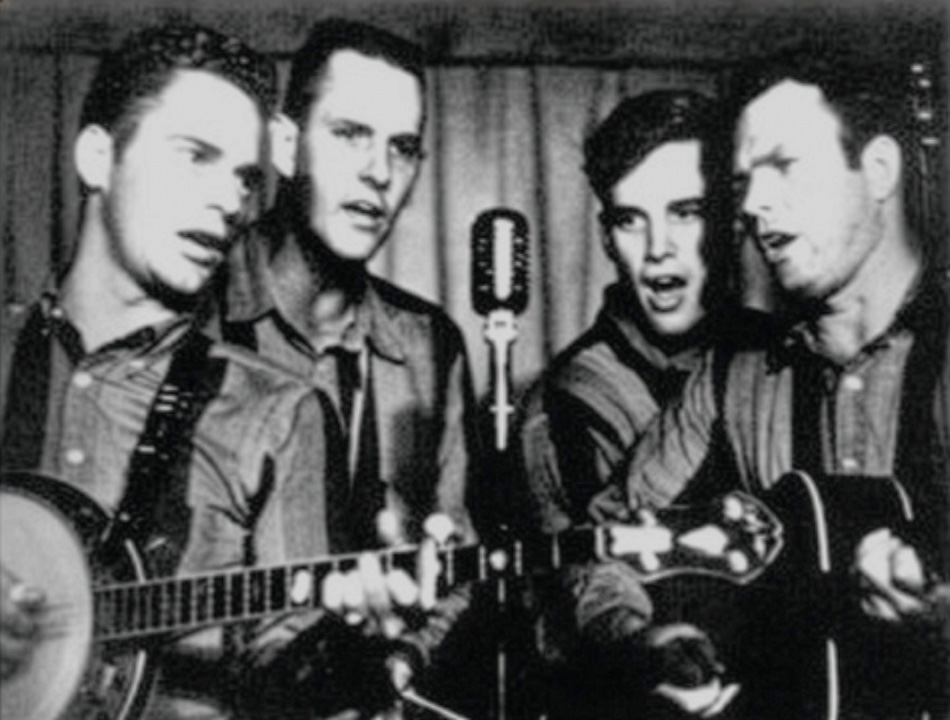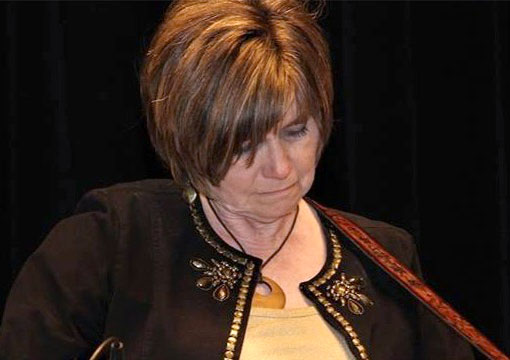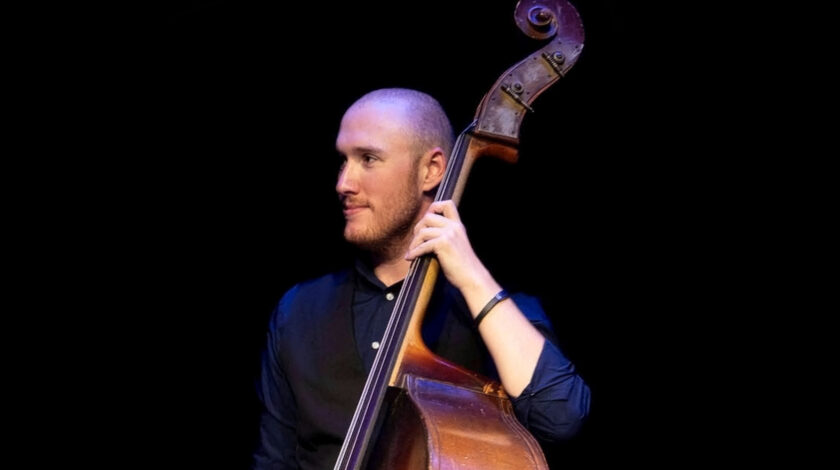
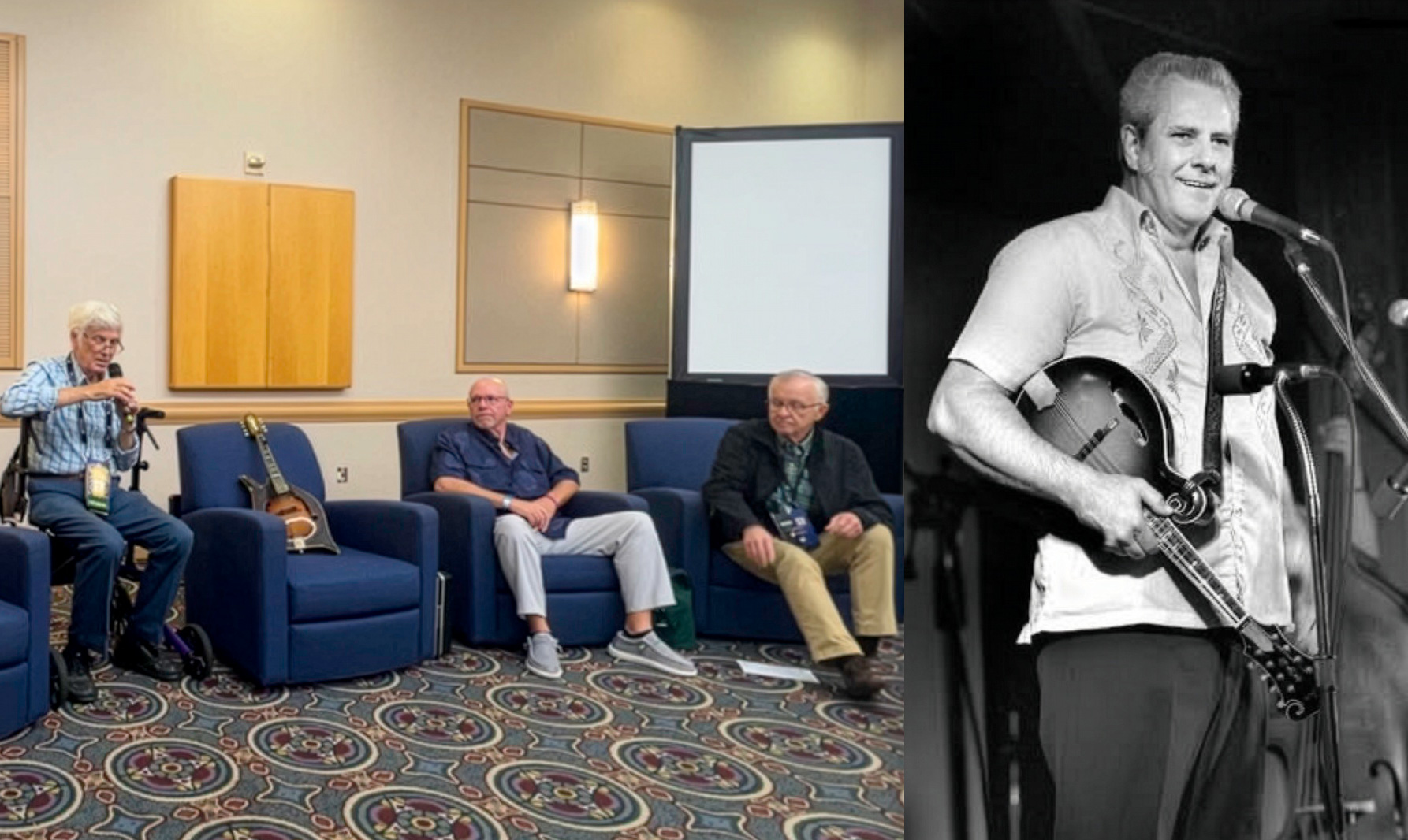
Tom Gray, Shawn Nycz, and Fred Bartenstein at a John Duffey seminar at WOB 2026 – photo © Sandy Hatley
John Duffey, the “Father of Modern Bluegrass,” was topic of one of the sessions during the IBMA Business Conference last week in Chattanooga. Duffey, who died in 1996 at 62 years of age, was a larger than life character who had a tremendous impact on bluegrass music. During the session, a panel of experts (Tom Gray, Fred Bartenstein, and Shawn Nycz) with first hand knowledge, sat down to discuss the huge shadow this iconic singer and musician cast on the bluegrass genre during his lifetime.
Tom Gray was John’s bandmate, playing bass in two ground-breaking groups with Duffey, first in the Country Gentlemen and then the Seldom Scene. He shared of his old friend…
“John was one of the original members of the Country Gentlemen in 1957. Bill Emerson put that band together just to fill dates [when Buzz Busby nearly died in a car crash].
John and Bill both grew up in Bethesda, MD. Bill Emerson used to describe holding his banjo on the handlebars of his bicycle as he rode over to John Duffery’s house. John coached him on the banjo and how to sing baritone. This was the beginning of the Country Gentlemen.
The term modern bluegrass may not apply today as to what we did in 1973. John had his own ideas. He really did change the nature of bluegrass music: the way it was being played, the way it was presented on stage, and the way performers got paid for what they did.
He was adamant about the band getting paid what they deserved. A promoter in California said, ‘I would like the Seldom Scene for a concert. I can pay you a thousand dollars,’ and John said, ‘Which member would you want for that money?’ He demanded more money than most promoters were used to paying. It was part of his business plan. We had a sellable item and he would demand more for it.”
Fred agreed.
“John Duffey asked for a reasonable compensation. Going into the bar scene, you were playing for tips or $20 a night for the band. We had a poverty mentality in bluegrass. Back stage I once asked, ‘John, if you had to do it all over again would you have done the career that you did?’ John said, ‘No, I wouldn’t. My uncle offered to send me to law school. I should have accepted that offer because I would have made something of myself more than I did.’ He brought a lawyer’s tactics to manage the organization. He helped bring the whole industry up to a new standard.”
Tom reflected…
“At first, the hard core bluegrass community was not quite ready to welcome our different way of playing things, although it really wasn’t that radically different. John had material outside the tradition, and with the direction of his performance. I think a lot of it had to do with geography. John and I were part of the Washington, DC community which was a mix of demographics. We were a community of city-bred people who were attracted to this rural music.”
Fred then shared a personal story when he was just 15 years old.
“In 1966, at the second Labor Day weekend festival that Carlton Haney put on, the Country Gentlemen were invited to be there. But they were not listed on the regular program, they were put on as a special act on Friday night because Carlton Haney wasn’t sure that the bluegrass fans would accept them. The bluegrass audience loved the Country Gentlemen. After then, the Country Gentlemen were one of the leading acts in bluegrass history.”
Next, Fred asked a rhetorical question.
“What does modern bluegrass mean? The more I think about it as a bluegrass historian, I think of an amphibian crawling out of the ooze. Bluegrass music until John Duffey’s era had been part of country music. It had not even had its own name. John Duffey was there at this amphibian moment. He had a band with four members, two from rural backgrounds and two from urban backgrounds recording country music on the Starday label, and simultaneously releasing folk music on the Folkways label. Some of the same tunes were being issued on both labels for different audiences.
Bluegrass music started with John Duffey being there when it became modern, and no longer conceived musically or commercially as being part of country music. It’s its own thing.
Were the Country Gentlemen really the first? In 1956, Red Allen and the Osborne Brothers were doing something very different, but never conceived it as anything but country music. In 1957, the Country Gentlemen emerged. John Duffey was there. The word ‘father’ implies that others follow. John Duffey was so iconic-lasting. Nobody could imagine trying to copy John Duffey. I think the word ‘pioneer’ of modern bluegrass is better [to describe him].
Tom expanded on how John gathered material for the Country Gentlemen’s repertoire.
“John had befriended Carter Stanley whom he asked, ‘Do you have any songs that a new band might record?’ Carter gave John the song, Going to the Races. That didn’t make Ralph happy.
[Our music] was a combination of the new and the old. As commercially necessary, artists had to sell themselves as folk singers in the late ’50s and ’60s. By the time I joined the Country Gentlemen in 1960, at age 19, Eddie Adcock had recently joined.
It was all Eddie’s idea to take the Gentlemen’s sound in a new direction because his [banjo] playing was so different from Earl’s and Ralph’s. Having been a lead guitarist in a band, he had nailed down the Merle Travis style of picking and applied that to the banjo. It was all Eddie’s idea of making bluegrass modern for that day.
Whenever we would start to work up a tune, John wanted us to try it in all three of the possible arrangements: either with lead in the middle (which is traditional) or on the bottom (like the Stanley Brothers did with White Dove), then the Osborne way with the lead on the top. That was a radical idea. With the powerful tenor voice of John Duffey, we certainly had the chops to do that kind of arrangement. We recorded 500 Miles that turned out to be a good vehicle for the high lead. John was looking for folk songs that could be arranged into our kind of bluegrass. We recorded I Know I’ve Lost You and John said, ‘This ought to go on Starday for the country people.'”
Shawn, who did the Seldom Scene’s record sales in the ’90s, displayed Duffey’s mandolin in the session.
“Most of you are familiar with Duffey’s iconic duck. The Seldom Scene was formed in 1971 and John didn’t even have a mandolin. He borrowed a mandolin until he built one. It was named ‘the duck’ basically because of its shape. He built two, one for Akira Otsuka of Bluegrass 45. John played it until [the Seldom Scene’s] Old Train album. It didn’t have a truss rod and the neck bowed so John stuck it under his bed and that’s where it sat.”
Tom interjected…
“At the time the Seldom Scene began, John did not even own a mandolin. He played an F-12 most of his life. Because he was a luthier, he made a higher bridge and cut the neck at a higher angle. He said, ‘That will give it more volume.’
When he was designing his duck mandolin, he said, ‘Those Gibson mandolins with the scroll, the scroll has no acoustic value at all. It’s just there for looks.’ So when he designed his own mandolin, it comes to fine points at the top to bottom which pick up the higher notes. This was part of his theory of acoustic construction. John made two of these mandolins. I invited Akira Otsuka [who owns the other] to be part of this panel, but he’s not able to travel.
There’s a very interesting story about how John got back his missing F-12. He had been playing at a night club in Washington. The band room was in the back where there was an alley. John had left his mandolin on the table and some thief walked by and was able to reach through the window and run away with John’s mandolin. He probably didn’t even know what he had.
He pawned it and another picker named JB Prince bought it at a pawn shop. He was playing in a band in Washington in ’71 or ’72. When the news came, John organized a posse of big guys that came into the club where JB was playing. JB had been warned. When John came in, he gave it back to him right away. John did help JB to buy another mandolin. John played the F-12 for the rest of his career.”
Shawn continued…
“Duffey was bigger than life, intimidating. Jimmy Gaudreu was probably Duffey’s favorite mandolin player. He would tell Jimmy, ‘Technically, you’re one of the finest mandolin players I know, but watching you play is the equivalent to watching paint dry. Sell it!'”
Penny Parsons played an actual interview from John Duffey, who stated…
“You don’t have to just play out in the field for the meadow muffins. There’s a market in the city. College kids really got into folk music then they found there was another acoustic music called bluegrass and we started getting college dates.”
Tom shared…
“John was proud of his range. John’s father was an opera singer for the New York Metropolitan Opera. After a few years, the pay was not enough and he moved to Washington and became a tour guide. He said, ‘John, I don’t care for the music that you appear to be attracted to, but if you’re going to sing let me teach you how to use that voice.’ He coached him to always sing from his gut, ‘You have a diaphragm, boy, use it!’ Incidentally, John Sr. never attended a concert where his son was performing.”
Fred recalled John’s association with Bill Monroe.
“When they would sing together, they would fight about who was going to sing tenor. If John said he was going to sing tenor, then Bill would say, ‘Well, we’re gonna sing it in the key of C.’ Just to see how high they could get it.”
Tom agreed.
“It was a funny relationship. John had said, ‘People treat Bill Monroe like he’s some kind of God. I want him to treat me as an equal.’ John would tease him to his face. It would go on for years. We would interrupt each other’s shows. Bill would get on stage and tell John, ‘I can tell you’re having trouble trying to sing that song.'”
The moderator concluded…
“It’s so wonderful to think about John Duffey’s spirit, his energy, and his music that has moved us all these years.”