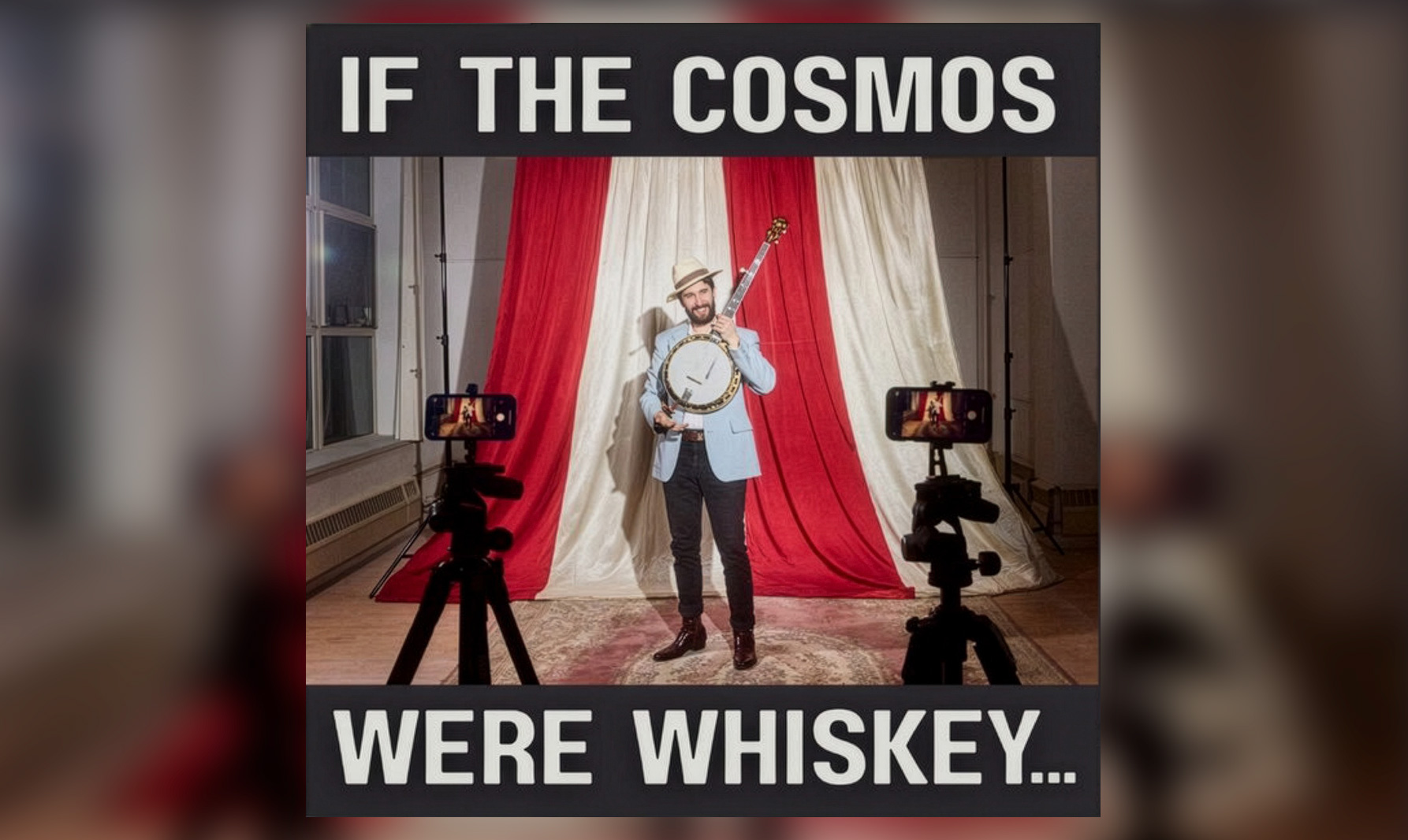
The title of Max Wareham’s If the Cosmos Were Whiskey… tells you a lot about the album: grounded in tradition but not tethered to it. The second solo project from New England banjo player, songwriter, and author Max Wareham makes frequent border crossings in and out of bluegrass, stopping along the way at some very interesting places. The press release says Max “moves effortlessly between songs that confront mortality and those that consist of a recipe for pancakes,” and if that piques your interest, you will likely enjoy this record.
First of all, Max knows his stuff: he studied with Bill Keith and Tony Trischka before enrolling in the master class in bluegrass that years of touring with Peter Rowan will provide. He immersed himself in the fundamentals while writing his book, Rudy Lyle: The Unsung Hero of the Five-String Banjo, where he analyzed every break the banjo pioneer recorded with Bill Monroe.
Max’s debut release, last year’s Daggomit!, does not stray from conventional bluegrass, but on this new album he expands his reach to include musical influences from J.J. Cale to Brian Eno. The result is a set of songs that are highly personal but still quite accessible for a listener who doesn’t know the backstories. To Max, this willingness to explore and incorporate has always been part of the history of bluegrass.
“What I’m trying to do here is embrace the weird in the tradition,” Max told Banjo Head Magazine.“I think about Bill Monroe’s drum and chant intro to Cheyenne. Despite its weirdness, it’s still very much within Monroe’s vision of bluegrass music.”
Max rejects the “preservationist-versus-innovator” debate as a false choice, pointing out that while Monroe set firm ground rules for his new style, he was never afraid to push past them. “You only have to listen to My Last Days on Earth with the string section and the seagulls to realize that there’s really nothing traditional about bluegrass. It is itself an incredibly creative art form.”
Most of the songs were written or co-written by Max, and are sometimes lighthearted and even silly, and at other times reverent and profound. Max’s soft and light vocal style recalls John Hartford or Peter Rowan at his most gentle. He frequently reaches for a falsetto, but without the intensity you often hear in bluegrass singing.
The album starts with a pleasantly loping straight-ahead banjo tune, but soon wanders off in different directions. I’m Just Along for the Ride explores what a Jimmie Rodgers blues might sound like if the protagonist happened to be a duck. The aforementioned pancake recipe song has an infectious swampy beat, and Nobody Plays the Zither Anymore has a 1930s cowboy vibe with the quirkiness of a Mike Craver song, but, you know, about zithers. Closer to You is a long, strange trip that would have been at home on Jefferson Airplane’s Surrealistic Pillow. The album closes with a sweetly sincere reading of the gospel song, Never Grow Old.
Max’s excellent banjo playing is supported throughout by guitarist and singer Jack Holland, bassist Chris Sartori, and drummer Karl Helander, and is joined on some tracks by vocalist Lily Sexton and fiddler Kathleen Parks. Alex Formento adds pedal steel to the zither song.
The musicians provide virtuosic picking that sounds relaxed and improvised without being sloppy or haphazard. The entire project seems thoughtfully constructed and well-executed, but with plenty of room left for whimsy and serendipity.
Max’s unconventional ideas extend to his production techniques, involving “re-amping” tracks in an abandoned coal silo to expand the feeling of depth, or bouncing them to a vintage Tascam cassette PortaStudio to get a more analog sound. The listener may not pick up on this kind of subtle experimentation, but Max’s hope is that they will respond to it in an emotional way.
Bluegrass tradition can be respected and kept alive in many different ways. One is to make music that sticks closely to the original blueprints. Another is to build new forms and structures on the original foundation. Both are equally valuable, and with If the Cosmos Were Whiskey… Max Wareham demonstrates his own idiosyncratic and very enjoyable way to balance tradition and innovation.