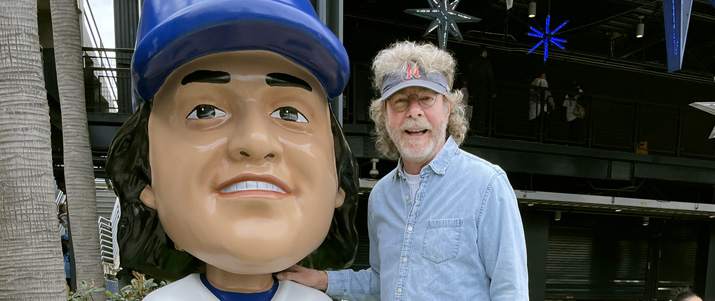
Sam Bush with Fernando Valenzuela at Dodger Stadium – photo © Lynn Bush
In addition to his many talents and vast array of achievements, Sam Bush stands out as one of the most amiable musicians one might ever meet. That’s immediately evidenced by the perpetual smile he has on his face whenever he’s performing for an audience… which, in fact, seems to be practically all the time.
With the advent of festival season and his consistent appearances at MerleFest and the Telluride Bluegrass Festival, Bush is about to embark on an annual cross country pilgrimage that will find him playing multiple venues over the course of the next six months. It’s a discipline he clearly enjoys given the fact it not only affords him an opportunity to reconnects with friends and fans, but to fulfill a desire he acquired early on, while still in his teens.
Bluegrass Today was fortunate to catch up with the ever gracious Mr. Bush during a layover in Los Angeles before he was due to venture on to a gig in Kauai. Given that it was his birthday, and his wife Lynn was taking him to see a baseball game that would pit the Dodgers against the Mets, Bush had every reason to be happy, a state of mind that appears to be a constant regardless of the circumstance.
“We’re taking a baseball stop just to break up the trip,” Bush explained. “There’s a little festival that we’re on the way to, where I’m a guest of Leftover Salmon and Kawhi in Kauai, Hawaii. So we’re on the way to Hawaii, and this will now complete the 50th state I finally get to play in. The only time we’ve ever been in Hawaii was just the Honolulu airport as a transfer and layover on the way to Japan, or maybe it was Australia…”
He mentioned that on his return he’ll only have a day and a half at home before journeying on to his next destination, which would be MerleFest, another of his many frequent annual appearances.
Nevertheless, the traveling doesn’t bother him. In fact, he insists that he enjoys it as much as ever.
“It’s just great at this age to get to see new things,” he insists. “I’m just very fortunate that I’ve been able to make a living doing what I love since I got out of high school, and I still love it. I’ve never enjoyed playing more than I do now. I’m fortunate that when the music starts, there’s a feeling that overtakes me, and I’m able to channel it. I’m not thinking about anything else. It can physically take away the woes or troubles of the day, and hopefully that can translate to the listener as well.”
Bush and his band continue to travel frequently, especially throughout the festival season which lasts well into the fall. By Bush’s estimate, they play roughly 80 gigs a year, but avoid extended month-long tours without a break at home.
“That’s kind of what we do,” he explains. “We are more of the three or four day a week kind of band. It’s a different MO from when I first started touring in 1970. Things change. There was a turning of the tide in 2020. Before that there were a lot of places where you could route shows on the way to other places. There would be festivals on different weekends and you could maybe route gigs through the week to get there and play in clubs along the way. I used to love to do city festivals, and there just aren’t as many outdoor festivals where you would find a real mixed bag audience. But funding really dried up for those type of things, like the city-sponsored festivals for the public. I really loved playing those events, because you’re reaching people that have certainly never seen you before, and they’re just coming out to have a good time, and hopefully they’ll be pleasantly surprised that they like the music.”
Nevertheless, he enjoys returning to the places he’s played before and seeing the familiar faces of those that make it a point to attend his shows regularly.
“It’s great to see friends that travel from different places to meet up at one of our shows,” he muses. “They bring their kids to our shows, so now that the kids are grown up, they’re coming with their kids. Plus, we don’t just have the kids of people that were in the audience. We have the grandkids of people that were in the audience. And that’s really wonderful in that they were interested in the music their parents was interested in, so that is amazing right there because that doesn’t always transfer to the next generation, but we see people with their grown children and their their grandkids coming to our shows. It’s really a wonderful thing and it elevates the whole experience. When the downbeat starts, I’m able to think of nothing but the music. That’s the goal of us playing on stage. If you’re in the audience, and you think about the loads of laundry that you should be doing, then I’m not doing my job.”
Indeed he does, and in many ways, he’s still the young kid who picked up a mandolin at age 13 and began what became an enduring, decades-long musical trajectory. In that regard, he still retains the same over-the-top level of enthusiasm. “I do because I’m still enthused about hearing new sounds and meeting new people,” Bush says. “I’m a fan and friend to musicians who are obviously much younger than me, like Billy Strings and Molly Tuttle, and especially Sierra Hull. I just really applaud them.”
Bush’s gratitude and enthusiasm are obvious. “I’ve had a few health issues up and down,” he explains. “And I probably eat too much sometimes, but I’m thankful to see those friends and see that they are doing well. Years ago, Bryan Bowers, my friend and the autoharp player, said it best: ‘Don’t ever take it for granted. We don’t know if we’ll get to see each other again. We just all assume we’ll get to, but we don’t know if we’re going to, so we can’t take it for granted.'”
In that regard, he admits that he was more or less forced to assume the role he has now — not simply as the support player he envisioned himself as early on, but as a band leader and lead singer.
“Yes, I’ve learned to do that,” he reflects. “When I first started playing music, my oldest sister, Marianne, who is ten years older than me, said a long time ago, ‘You used to be such a shy little boy. How did you get over that?’ I said, ‘I don’t know.’ Maybe it’s the applause, but I’ve learned to enjoy communicating with the audience, whereas once upon a time, I would have been intimidated, and I was very shy, especially in singing in front of people. That was hard for me to get used to. I grew up as an instrumentalist who sang on choruses. Eventually, I had to become a lead singer out of necessity, because the lead singer had left, and I had to start doing it all myself. With New Grass Revival, I did some singing and I was actually the lead singer in all our choruses, but John [Cowan] was the only natural tenor singer we had. So I had to sing lead on the choruses. When I was playing with Emmylou Harris, she kind of coached me about singing, and ways to accomplish more with my voice. And so I just got more comfortable doing it. I also think that when you get to a certain age, you think, ‘well, this is the way I sing. If you don’t like it, go see somebody else.'”
Bush claims he never experienced the proverbial “a-ha moment” where he suddenly came to the conclusion that music would be his life’s work. “Honestly, I don’t know if I ever had one,” he reflects. “I think there are certain moments that stood out, and I might not have even realized it at the time. I was lucky enough to take a road trip for the first time in 1965 at age 13. That’s when I went to the first multi-day bluegrass festival in Roanoke, Virginia with my dad, and we drove all night from Kentucky to get to Roanoke, and we got there around ten or eleven in the morning. We pulled up to this farm in Virginia, and there was this field with eight or nine jam sessions going on at once. And I went, ‘Oh, my God, people are jamming all over the place.’ And I had never seen anything like it, and before I knew it, I was in a jam session and playing along. It was like the ‘ movie, where they said, ‘Is this heaven? No, it’s Iowa.’ In this case, it was, ‘Is this heaven? No, it’s Roanoke,’ and, to put it another way: ‘Is this heaven? No, it’s bluegrass!’ The community of friends I made at Roanoke are still friends to this day.”
Ultimately, one has to wonder — with all the kudos, awards and recognition he’s received, does Sam Bush still have a bucket list?
“Honestly, I’m just trying to improve as a player and singer,” Bush replied. “I don’t know how you do what I do when you stop trying to improve. Also, things continue to come along, and I still get to meet new musicians in different types of bands that I get to fit in with and share in their music. I’ve always been fortunate that I’ve been hired to play along with other people while getting to play my own kind of music as well, with my own band. I get to play new types of music that I haven’t played, and I don’t always know when it’s coming. There’s a band I’m going to play with in May called Toy Factory, an all-star Southern rock tribute to Marshall Tucker Band guitarist Toy Caldwell led by drummer Paul Riddle. So it’s a rock and roll band, but it’s got Marcus King on guitar and Charlie Starr on guitar, wow, and Otei Burbridge on bass. And so I’m gonna guest on four shows with them somewhere. So again, you never know. There’s different kinds of music that I get to play, and that’s what’s always interested me, and that interests me with our bands too. So I don’t really have a bucket list, per se.”
In that regard, Bush mentioned that he and his band are in the process of recording some new tracks. “It’s a little bit at a time,” he mentioned, and some of these tunes we’re playing, we’ve never done anything like them. We’re trying different things, and so it’s fun. That’s one of the things I love about Telluride Bluegrass, for instance. And World Fest too. You have different types of music, not all just one type of music throughout the day. That’s certainly the most interesting to me.”