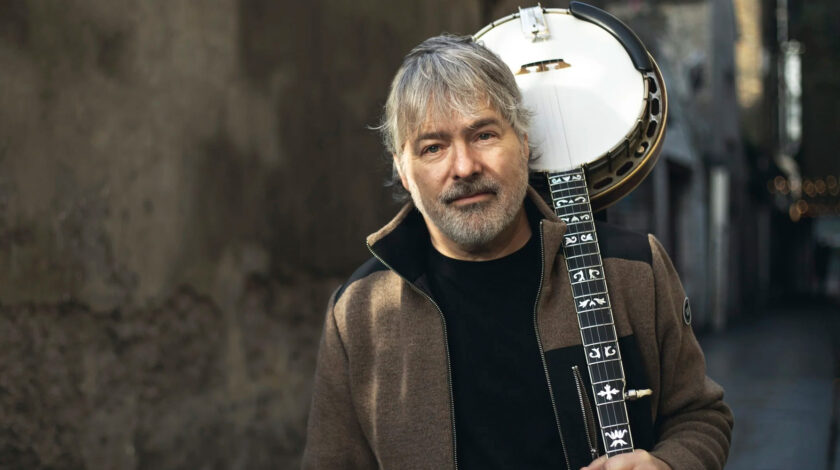

Dug performs at the 2025 Telluride Bluegrass Festival – photo © Jen Hughes
One of the myriad delightful aspects about the Telluride Bluegrass Festival (TBF) is the opportunity for festival-goers to discover new (or new to them) bands. Planet Bluegrass, the fest’s organizer, never disappoints. It scours shore to shore and across the globe to see what acts are sprouting from the musical soils. This is the crew that brought us Mumford & Sons at TBF in 2010 for crying out-loud. It knows what to look for and picks them to play at the Fred Shellman Memorial Stage at just the right time. This year, TBF52, Planet Bluegrass unearthed another treasure with its planting of Dug, a Dublin-based duo comprised of Lorkin (Conor) O’Reilly and Jonny Pickett, on that main stage.
Soon after Conor’s resonator guitar picking and Jonny’s clawhammer frailing kicked off, our attention was caught: we knew we were in for a journey. When Conor and Jonny dropped in with their vocals, that journey was undeniably and wondrously placing us simultaneously in the hollers of Appalachia and the pubs of Doolin. Conor sings from deep within his soul, jolting ours with his great gravelly voice. It is a voice that harkens us back with a late 1800’s sound, but one that croons catchy wise and whimsical modern-day lyrics, which drives us into new times. His brilliantly pervasive foot stomps become the audience’s collective heartbeat as we gaze transfixed at these musicians, our heads nodding along. We are mesmerized at how these two (come to find out) humble men are creating such powerful and beautiful sounds that transport us across the centuries and two worlds, yet also firmly ground us in the moment.
Jonny’s banjo playing, harmonizing voice, and, indeed, his tambourine tied to his ankle perfectly blend in the other essential ingredients to make Dug’s unique sound. Jonny and Conor’s respective talents go together like Jameson and ginger ale. So smooth. So tasteful. Such an unquestionable winning combination. The elixir Dug serves up is Irish/Americana fusion, with a massive nod to past traditions and a keen cutting-edge bent, spawning some of the hippest sounds around right now.
Bluegrass Today had a chance to dig into Dug during the TBF just after the band’s Elks Park set, where Conor and Jonny had the crowd up and delightfully dancing at 11:30 a.m. What a joy to get to know these lads a little bit as they inevitably skyrocket to stardom.
JH: Can each of you please talk about your evolution as a musician and how you became to be one? Was it important in your family life or in your background? Please talk about the point that you realized that you wanted to do this as a career.
Conor: I always wanted to play guitar and do music. It wasn’t in my family at all, but my Dad kindly went and got me a guitar. More recently, there was a shift I had. I was on tour with a band called The Scratch, and I was doing the merch for them, and at that point I had been doing a solo career. I wasn’t really engaging with music in a way that I felt was fully committed. I was kind of like: it was part of my life, but it wasn’t my full focus. I spoke to Jordan who was their guitar player at the time, and he was saying that he started on a tin whistle. He realized, he said to me, that when you are a musician so much of your self-worth is wrapped up in your own perception of your ability, and that learning something new is really hard because you have to be crap — and being crap is something that your self-worth is really wrapped up in. It’s really difficult. That was a really important thing to hear. After that conversation, I went back — and I always wanted to play the resonator with a slide and picks — and I kind of just locked myself in my room for few months to learn how to do it. And, I sucked! I was really bad for like two to three months. But, I was slowly getting better at it. So, I think that was a really transformative moment in my musical journey.
JH: I read a little bit about your background. It seemed like you had sort of a winding path, but you knew you always wanted to do music from the beginning?
Conor: Definitely. I didn’t graduate; I failed high school. So, university wasn’t really an option, and, music was always the thing I could do. It was something that I could be doing at home all the time. I kind of always knew I wanted to do it, but it took me a while to get here. I did construction for a long time, and I did lots of jobs to just try to support me doing music. I feel fortunate in the fact that I have never really questioned what I wanted to do. It is a funny thing to have an idea of what you want to do when you are eight and then still doing it when you are thirty. You have to question it at some point, I guess.
JH: How about you, Jonny?
Jonny: Music is definitely in my family. When I grew up, my dad was a minister of music at a church for 25 years. So, I grew up playing in church every week. It was a nice environment because they just wanted people to volunteer, and they pretty much let me play whatever I wanted. I could mess around on the drums one week, the bass the next, the guitar the next, and the banjo the next. So, I was just doing that a lot, and I was making and writing songs pretty much as long as I can remember. I started on piano. But, it never occurred to me that you could do music. I didn’t really have that sense that I want to do this in my life. Then, I went to university and I decided to study music. I went with my banjo and the staff literally laughed and said there is no way you are playing banjo at the university. So, I started practicing double-bass: 90 minutes in the morning and 90 minutes in the evening right before college started, and I convinced them that I played double-bass so I could study music.
I ended up doing that all undergrad — while playing banjo in a few bands. I really got my chops more when I moved to Ireland. I was playing in pubs every week with one my best friends. We just played every single week and they gave us pints every single week. We played until forever. That was when I realized: wow, I am paying my groceries with this. That’s nice! I still don’t believe it is possible to do music. I’m sitting here, and I know it is crazy, but I am still like doubting Thomas. It is too good to be true.
JH: Elks Park [the set they just finished] was evidence right there, I have to say. You’re from California, but then moved to Ireland?
Jonny: Yes.
JH: And, you, Conor, are from Scotland, but Irish?
Conor: My Mom is Irish. Classic Scotch-Irish. My parents were in Australia, classic ’80s kids from Scotland and Ireland who moved to Australia because there was more work there and they met — and that is how I came into the world.
JH: And, you moved to Upstate New York?
Conor: When I was 18, I moved to Upstate New York, to work on a farm. I sort of escaped. I couldn’t go to university. I didn’t really know what to do so I was like: farming sounded nice. I really wanted to get better at guitar. I figured if I could farm during the day then I could play guitar in the evening. And, that was kind of as much thought as I gave it. I ended up getting married and staying out there for ten years.
JH: How did you two guys meet and how did it evolve into becoming Dug?
Jonny: We met through my ex-girlfriend. She is songwriter and has a band called Lemoncello. [Turns to Conor] I had heard about you years before I met you though. We almost met in New York in 2019, but we missed each other by an hour or so. He drove back up when I was landing or something — and then we met in 2022 in Ireland.
Conor: It was through mutual friends. Jonny was Laura’s California boyfriend and we finally met. There was no plan to start a band and do this. It just kind of happened naturally. It was out of necessity. We were both unemployed and we just started playing tunes in the living room. We were like: damn, this kind of sounds good; maybe we should bring it to the street and plug it in and see if we can busk. And, that was it. We started busking. We put a QR code up. Then, we booked a gig — and people showed up to the gigs!
Jonny: It sold out, and we didn’t have any music out.
Conor: Yeah, we sold out two gigs without having any music out. And, then it was like: maybe we should record something. So, we called up our friend, Josh, and recorded the songs that we were playing on the street. And, that’s half the record. So, there was no plan; it just happened.
Playing in Dublin on the streets was instrumental. We were playing for three hours every day. It was a lot of playing. You really figure out how to play with someone and the intricacies of the set, and how to hold an audience and try to get people’s attention. Without being cheap, Jonny added.
JH: And, when did you become Dug?
Jonny: We started an Instagram account and we were so embarrassed because it was at zero.
Conor: We didn’t tell anybody. We didn’t even tell our friends [laughter]. We just put a QR code up on the street and said: if you like this music, follow us. And, that was it. We were kind of like: do we make an Instagram account? It felt kind of embarrassing.
Jonny: It was really embarrassing. Starting a band in your 30s is so embarrassing [laughter].
JH: When people ask you what type of music you play, how do you describe it to them?
Jonny: Sort of Americana with a sometimes Irish folk twist.
Conor: Old-timey.
JH: Where do you find your inspiration for your song-writing, and are there any musical heroes that you draw from?
Jonny: I’d say pretty much all my inspiration comes from other songs probably. I’d like to say I just finished this book and I wrote a song about it. But, I think I get most inspired by other people’s songs. Conor added: Or, what’s that line in a TV show? Jonny: Yeah, single lines are pretty nice.
Conor: Learning Chris Smither tunes for me — that was big in like 2022. I got really into trying to learn more of his stuff. And, his lyrics are absolutely masterful.
Jonny: This last year, my musical heroes have been Paul Brady and Andy Irvine. They have an album from the ’70s together and it has just been on repeat for like a year and a half. I can’t stop listening to it. I saw Andy Irvine in Dublin a couple months ago and it was the most inspiring thing ever.
JH: When you get the spark or a line from a TV show how does the creative process between the two of you work to bring the song idea to fruition?
Jonny: We are still trying to figure that out. Conor had five-to-six songs to start with. There were a couple that were like 2/3rds done that we finished together. And, then, I kind of brought some old-time tunes. It is pretty collaborative.
JH: You have your first album coming out, can you talk about any particular things you are proud of about the album?
Jonny: I am really proud of the first track as an opener to the album. I think it came out really nice.
Conor: We recorded the album in about three different places so it was a delicate job making it all feel seamless. We went to Liverpool and recorded some tracks. We weren’t super happy with them originally. But, they came out really nice. I was really happy with the ones we did in Liverpool. Livelong Day, which is out, is one of those songs.
JH: When you are performing what do you hope the audience walks away with?
Conor: From the very beginning, it was really important that we wanted the project to be positive. We wanted people to have a good time. It is easy to be serious and there is space for that. But, I think we wanted to create an environment where people could enjoy themselves, and leave with a feeling of positivity.
Jonny: A break from the phone in your pocket — that is what I hope you’ll take away. That they actually don’t think about their phones at all.
JH: I’d like to ask about your experience at the Telluride Bluegrass Festival.
Jonny: When we got the email saying we were playing the main stage, I was like: this is actually a mistake. I thought our booking agent made a mistake and sent it to the wrong band.
JH: Can you give me your impressions about walking out on the TBF Main Stage and what it felt like with that audience and that scenery?
Conor: It was, unfortunately, shrouded in the fact that my guitar broke twenty minutes before we got on stage. I cannot speak for Jonny, but, as for me, I was sweating buckets. I was so stressed. It felt like a nightmare, but then I got a text right before walking on stage from the luthier who built my guitar and he said: I’ve seen worse breaks last longer, so you will be fine. I didn’t believe him until about halfway through the set. At that point, I started getting into it. I was like: I think we are going to be alright. But, it was touch and go there for starters.
Jonny: I was trying to grasp it, telling the story back to myself: okay, we started a band and then we were busking and now we are here. I was trying to make sense of it, and I couldn’t really do that, to be honest. I was trying to explain to myself: Okay, Conor’s guitar is kind of broken. We are going to do the same thing we always do, but this stage is literally like 50x bigger than any stage we’ve ever played on. I was trying to explain to myself nicely, like to a kid, that this is what is going on.
JH: You were very gracious on stage about how the audience was very attentive. Any further thoughts on that?
Jonny: They are unbelievable. I don’t know that there is a bad audience, but there are just some audiences that you make you feel good and that actually looks really different sometimes. Sometimes, they are yelling and being rowdy, and that makes you feel great. And, then sometimes, they are just totally locked in and that makes you feel great as well.
Conor: It feels like it is all musicians in this audience. They are listening and focused.
JH: Any favorite things about the Telluride Bluegrass Festival?
Jonny: I love coming down the hill in the gondola. That is mind-blowing: taking a gondola to the stage you’re playing is crazy!
Conor: Watching Tim O’Brien was pretty special. I really enjoyed that. He was fantastic.
JH: I saw him watching you at Elks Park. That was cool.
Jonny: Was he there?
Conor: I am glad I didn’t know that! [Laughs].
JH: If you could play with anyone dead or alive who would be your dream person to sit down and play with?
Jonny: Well, you want it to be a good hang as well. Andy Irvine and Paul Brady. They are both alive. We have friends who play with them all the time.
Conor: I feel like I would go for a tune with Planxty in ’76. That would be wild.
Jonny: Half the people on stage here. Half the people I would give up a finger to play with. The other half, I would give up two fingers.
JH: Anything else you want people to know about you?
Conor: We are going to be doing a lot of gigs in the next year. So, keep an eye on our Instagram and website.
Jonny: And, tell your friends. We are still blown away that anyone shows up. Thanks for coming if you come to a gig.
If you have not heard Dug yet, you will soon. Get a head start and dive in that dirt and see what has sprouted. We expect you will be elated with what you find — from Dug’s deep groovy melody o,f Livelong Day to their smiley, bouncy Wheel of Fortune to that beckoning resonator, that alluring clawhammer, and that unmatched spirit of Jubilee to so much more. Get your shovel; let’s get going!
Dug’s debut album called Have At It is available now online. This November, Dug will be the opening act for several shows with The Wood Brothers.