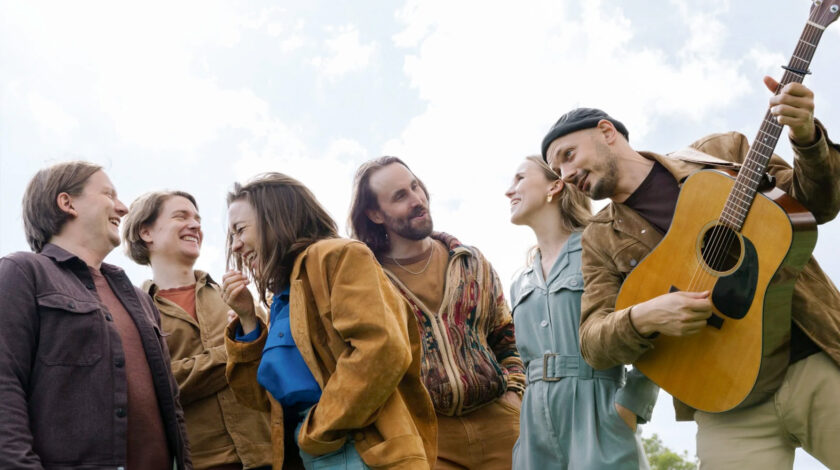

Katie Powderly is a musician in Frederick, MD with a new idea for a charitable organization. The daughter of a bluegrass picker, her own music tends more towards an Americana, singer/songwriter sound, though she retains a love for the music from her childhood.
Her philanthropic project has the simple title, Guitars For Girls, and is being run through Katie’s record label, Red-Winged Blackbird Records. It’s an all-volunteer effort to “equip young girls with the tools, confidence, and community to tell their stories through music, by providing guitars to girls in our program at no cost to them.”
Things started slowly last year when Katie was able to donate a guitar to a girl who wanted one, and she has now expanded to where she thinks they can donate 20 guitars to young girls throughout the Appalachian region. She reached out to us, not looking for donations, though Guitars For Girls depends on contributions to fund their efforts, but hoping that our readers might be able to nominate some girls, aged 8-17, who would be deserving of a new guitar.
They are looking for girls with an interest in Appalachian traditions of storytelling, songwriting, and American roots music. Nominations are open for those in the wider Frederick, MD region, and throughout the states of Alabama, Georgia, Kentucky, Maryland, Mississippi, New York, North Carolina, Ohio, Pennsylvania, South Carolina, Tennessee, Virginia, and West Virginia.
Anyone can nominate a girl for a guitar, a parent, teacher, family member, or friend, or you may nominate yourself. A form for that purpose can be found online.
Let’s have Katie explain a bit more about her motivation and her thinking in seeking candidates for Guitars For Girls.
“This is officially year two of the program, though the idea first came to me back in 2011. At the time, I was releasing my debut album, touring, and transitioning away from Madison, WI, as my home base. I began shaping the concept — even commissioning a logo — but ultimately paused. I knew it needed to be done right, and I didn’t yet have the bandwidth to give it the structure and intention it deserved.
That time is now. Last year, I privately funded the project’s first effort by gifting a guitar to an 11-year-old girl named Andy M. from Kentucky. Her school only offered band or orchestra, but she dreamed of learning guitar and writing her own songs. After reading her poems — which were more poignant than songs many adults were sharing with me — I knew she had something rare. I wanted her to have the tools to nurture that gift from a young age.
It takes one to know one. I was the daughter of a bluegrass banjo player and flatpicking guitarist father and an artist mother who painted. Since childhood, I was a sensitive artist and performer — drawn equally to sound, color, and story. In many ways, it was my fate to become a bluegrass bass player, songwriter, and designer. Music and art run in my family on both sides for generations; it’s both our heritage and our destiny. When you’re born to do this, you can recognize it instantly in someone else — that unmistakable spark in a child who’s destined for a creative path.
Not every kid has the same access to opportunity, though. You shouldn’t have to come from money to have access to possibility. Making music and sharing it with the world is far more expensive than most people realize, and I believe we risk losing culturally significant art if only the wealthy can afford to develop their talents. Bluegrass, folk, and country were born as working people’s music — I say that with pride. Our stories are real, they are impactful, and they deserve to be told.
There’s also something deeply transformative about someone seeing you as worthy of investment. I’ve been on the receiving end of that kind of belief, and it changed the trajectory of my life. It made me take myself and my gifts more seriously. That’s what I hope Guitars for Girls does for these young women — helps them see themselves as valuable, capable, and creative forces in their communities.
My goal is that this program will perpetuate the traditions of American roots music, increase the confidence of the girls we invest in, and encourage original songwriting as a mechanism for telling their own stories.
This year, I’m expanding the program with community support to reach more girls across Frederick, Maryland, and the broader Appalachian region. My organization, Red-Winged Blackbird Records, hosted a sold-out fundraising concert here in Frederick earlier this year, featuring my electric band (The Unconditional Lovers) and The Fly Birds. We offered tiered ticket pricing so that no one was excluded due to cost — and the community response was tremendous.
We also partnered with a local tattoo shop, Classic Electric Tattoo + Piercing, for a creative fundraiser: the artists designed a page of music-themed flash tattoos and donated their time so that proceeds could go toward the program.
Between those efforts and a handful of generous sponsors — including local businesses and private donors who’ve provided everything from guitar straps to legal counsel — we’ve built enough momentum to equip around 20 girls this year with guitars and essential accessories. I intend to continue growing the program sustainably each year.
Regarding the instruments themselves, my plan is to provide smaller-bodied acoustic guitars suited for young players — lightweight, comfortable to hold, and easy on small hands — while still offering a full, inspiring tone. I want each girl to feel that what she’s receiving is a real instrument worthy of her potential.
When people ask me why I started Guitars for Girls, the answer always comes back to a feeling I had during the uncertainty of 2020 — the sense that ‘somebody should do something.’ Something to bring people together, to offer hope, to invest in what unites us. Eventually, I realized I was somebody. So I got to work.
I’d love for your readers to know that this project isn’t just about guitars — it’s about legacy. It’s about planting seeds for the next generation of Appalachian storytellers, and giving young women permission, opportunity, and tools to find their voices through music.”
If you know, or are, a girl aged 8-17 who could benefit from this program, you can nominate her, or yourself, online.
Hats off to Katie Powderly and Guitars For Girls for taking on this worthy endeavor.