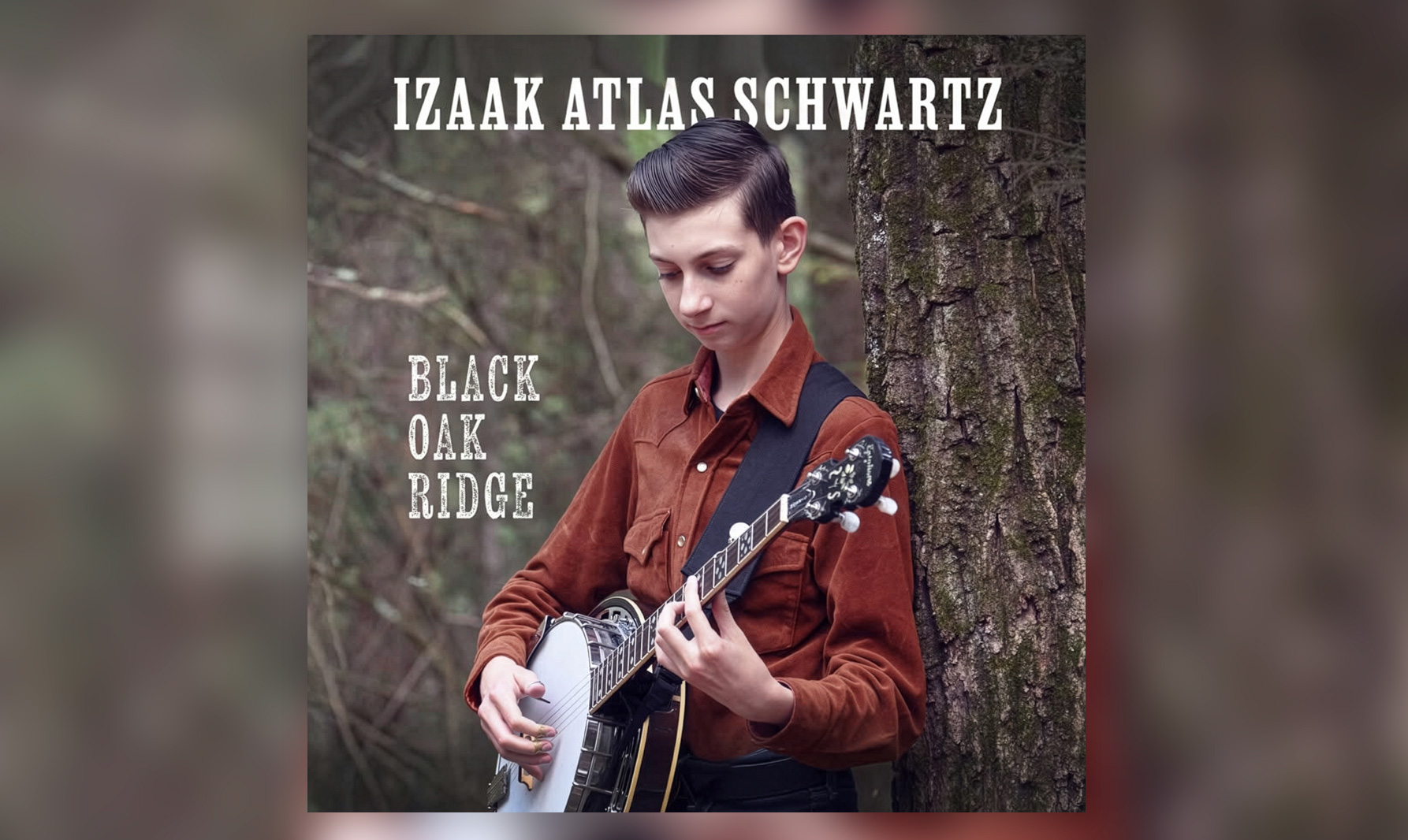
Izaak Atlas Schwartz has released Black Oak Ridge, a strong debut album showcasing his mature banjo skills and compositional ability. Both are even more impressive when you learn that Izaak was only 14 years old when it was recorded, mostly live, at Patuxent Music.
Alan Munde provides a well-written appreciation in the liner notes, which is fitting as Izaak’s choices of tunes and style recall Munde’s wide-ranging taste and sensibilities. He recounts how Izaak, coming from a musical family, was able to pick up and play classical melodies by ear on the piano from the age of four.
In 2017, the family moved from Virginia to the Pocono Mountains of Pennsylvania, where they became immersed in Appalachian traditional music. Banjo was not Izaak’s first choice, but he had a chance to study with Berklee graduate Trevin Nelson (formerly of the Ruta Beggars) and it only took him a couple of weeks to be able to jam, playing breaks and learning tunes quickly. In just five weeks he found himself playing on stage with a band.
What makes this eye-popping natural talent truly special is how Izaak combines it with curiosity, inventiveness, and impressive discipline. This young man has not simply rested on his natural gifts, but sharpened them by spending hours practicing scales with a metronome. He uses that strong foundation to create his own licks and breaks, write his own tunes, and develop his own style.
More than half of the tunes on the album are Izaak’s originals, and they are the standout tracks. Although they are instrumentals, each one has a complete backstory: Black Oak Ridge was inspired by a true murder story and has an appropriately menacing feel, while Ol’ Blue does a great job of placing you behind the wheel of his grandfather’s old truck.
Dingman’s Drop, based on the cascades of a local waterfall, is full of playful twists that recall Tommy Jackson’s Crazy Creek. The fast-paced Icy Holler perfectly captures a hair-raising adventure the Schwartz family had driving on an icy gravel road. The originals are filled with interesting melodic ideas, using music to paint vivid images. As Munde says, “Schwartz is very good at telling stories with his music.”
Izaak is adept at clawhammer banjo as well, and plays two tunes in the old-time style with a delicate and lively feel. He also lays his thumb into a few well-chosen tunes from the bluegrass repertoire, with both Faded Love and Don Stover’s Rockwood Deer Chase featuring special guest Michael Cleveland on “second fiddle” (as he is credited in the liner notes). Allen Shelton’s Shelton Special sounds energized and lively as ever.
Especially nice are South (Foxtrot) and Waiting for the Robert E. Lee, a pair of Dixieland jazz tunes chosen with the help of producer Tom Mindte. Izaak initially found them challenging to convert to bluegrass, but eventually was inspired to give them Earl Scruggs’ Farewell Blues treatment, and the result is charming.
Perhaps less successful is an uptempo instrumental arrangement of Come Thou Fount of Every Blessing. The beauty of the old hymn seems obscured by the bluegrass treatment, reduced to just another jaunty melody. It will be interesting to see if, once he has a few more years behind him, Izaak might play a piece like this with a bit less pep, imbuing it (even when played instrumentally) with as much emotion as he has put into the originals.
The album ends with the only vocal, Everyone Has to Answer. A quartet led by bass player Michael Johnson, the gospel song was written by the late Donnie “Dobro” Scott, a beloved Mt. Airy musician and raconteur.
This excellent first effort proves that Izaak Atlas Schwartz has the tools to go as far as he wants to as a musician. It will be fun to watch his journey.