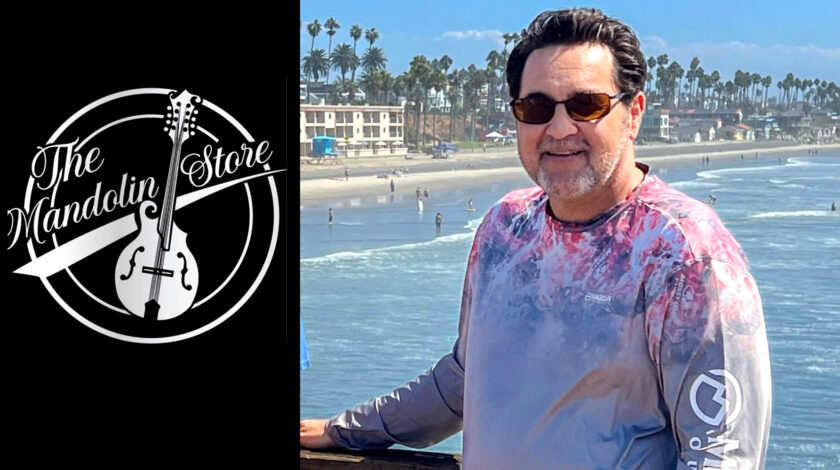

Greg Rich has had a long and intimate relationship with the banjo and bluegrass instrument-making business. A skilled craftsman, his work as a banjo builder, and especially as an engraver, woodcarver, and fingerboard painter, are at the apex of the industry. He may be one of the few, if not the only artist readily capable of exact replicas of the elaborate Bella Voce and Florentine fingerboards that once decorated the most ornate banjos Gibson ever made.
The short-lived Rich & Taylor banjo company was a partnership between Greg and Mark Taylor, son of noted reso-guitarist Tut Taylor. They made very high quality professional banjos starting in 1993, with several models that are now highly collectible, including signature models for Sonny Osborne, J.D. Crowe, Don Reno, and Terry Baucom. They went out of business in 1999.
Before that company started, Rich had been hired by Gibson to get their banjo building back on track in 1987. From the glory days prior to WWII, and even through the early 1960s, Gibson Mastertone banjos were the standard instrument for bluegrass players. Used in the defining years of bluegrass music, very nearly every banjo player was using a Gibson, from Earl Scruggs, Don Reno, and Ralph Stanley on down.
But the company was sold in 1969 to a consortium that became Norlin Industries, and historians and players of musical instruments are in uniformity in their belief that the quality of Gibson products deteriorated through this period. The banjos of the 1970s and early ’80s were a mere shadow of Gibson’s superb pre-war instruments.
When Gibson was subsequently sold in 1986 to Henry Juszkiewicz and David Berryman, the quality soared rapidly, and Rich was brought in specifically to salvage the hard-earned reputation of Gibson banjos. Basic construction details improved so much that the period between 1987 and 1993 while he was with the company are known in the banjo world as the “Greg Rich era,” with those instruments especially prized.
After the demise of Rich & Taylor, Greg began to dedicate himself to helping to build less costly banjos for students as well as more serious players unable to justify the high cost of US made professional-grade instruments. In 2000 he went to work for Saga Musical Instruments, and helped them relaunch their Gold Star banjos which had been popular in the 1970s, and were made in Japan. The new Gold Stars were built in China, to a very high standard, and were welcomed in the market by buyers.
We spoke with Greg at length yesterday about his most recent endeavors with The Music Link, the company who has produced instruments under The Loar and the Recording King brands, and which has just laid him off as the company is going out of business.
Our first suspicion was that this was a result of the recently-instituted US tariffs on all items manufactured in China.
“It wasn’t the tariffs, though they were the final straw. This is a result of mismanagement, and poor marketing and production choices. They made great stuff. Just look at the artists that signed with them.
It’s a shame – 20 years, gone.”
The Music Link was a partnership between US entrepreneur Steve Petrino, and Alan Liu, who owns the AXL factory in China where the instruments are made. The two launched the company in 1997, and brought Rich in as chief of design in 2005.
“I really liked the owners. They gave me total control over product development. Travis Atz did all the direct work with the manufacturers; he and I worked together with prototypes and samples.
Then July 7 I got an email from Steve, a termination notice. All of the employees are gone except a few left in the office winding things down.
I own the names Recording King and Loar; gave them a 40 year licensing deal. Will they sell those names if they go bankrupt? They were already several hundred thousand dollars behind on my royalties.
I’m OK, but I really feel badly for the employees.”
While Greg doesn’t believe that the tariffs were the primary reason for the demise of The Music Link, he does see very bad signs for the imported musical instrument market if they aren’t resolved quickly.
“It’s caused an industrywide panic. I understand what the President is trying to do, but it’s going to damage a lot of companies.
I hope it works out. If your pocketbooks are deep enough, and you can wait it out, maybe some companies can get through until the tariffs come down. Until then, it’s going to affect every product. It’s all going to go up.
We could lose hundreds of thousands of workers and businesses over here.”
He is referring to the fact that very nearly all entry-level musical instruments are manufactured in China, including all the ones used in the school music programs. Not just stringed instruments, but brass and wind as well. Millions of these are imported into the US every year by a number of companies, and adding 145% to their selling price, as these tariffs do, will be a tough pill to swallow.
Of course the current administration says that it is this Chinese monopoly of manufacturing in multiple industries that they are trying to disrupt. It will be deeply felt in the bluegrass world until the issues are resolved.
So we wondered whether this meant retirement for Greg Rich.
“I actually just started collecting social security, but I can’t retire. I want to stay busy. I’ll be available for consulting work, and probably build a few pieces a year.
I still teach banjo engraving for free to anyone who wants to learn it. People are invited out for the weekend, and we work in my studio here at home.
I also teach people how to paint the Florentine banjo fingerboards.”
Rich had done all the engraving for Sonny Osborne’s Chief banjos, and the more recent Krako banjos made in cooperation with Lincoln Hensley. For the uninitiated, Krako is a mythical character Sonny insisted was responsible for banjo mishaps of every kind, whether mistakes made while playing, or problems with banjo set up.
“Yeah. I did all the Krako parts for Sonny. I asked him to sketch out the little demon figure as he imagined it, and based the engraving on that.
I also did engraving on the Chief banjos, but I never made anything for it. One night I was talking with Sonny in the Banjo Hangout forum, and people were asking if there would ever be a gold-plated and engraved Chief. So I jumped in saying that I would do the engraving for free for anyone who ordered in the next hour. Sonny got a couple dozen orders in that hour!”
Finally, we talked about bit about Greg’s time at Gibson.
“I came in as banjo supervisor in 1987. My job was to get banjos up and running again. We started with the Granadas, the 3s, the 4s, the Earls. We got them to where they were very consistent.
I ended up head of the Gibson Arts Instruments. After I left, the parts supply wasn’t consistent, and things changed.
They fired me when I wouldn’t sell my name. They called me in and said they wanted to buy the rights to use my name. When I refused, they let me go.”
We couldn’t resist asking what he thought about the fact that Gibson has lost the right to their Mastertone trademark, and has stopped making banjos.
“How does a company that built its reputation over 100 years making guitars, banjos, and mandolins, and selling to small family dealers let that happen?
It happens for one reason. Greed. Simple greed.”
In closing, Greg Rich says that it’s been a great ride.
“I’ve had a great time doing this, and I still going to be doing it.”